
Competitive procurement is fiercer than ever. Buyers are scrutinizing every word of your proposal, deadlines are tighter, and margins thinner. In this landscape, generic proposals won’t win. What separates high-performing teams is a buyer-centric bid writing approach—one that leverages compliance depth, strategic win-themes, data-driven scoring tactics, and now, AI-enabled workflows. This comprehensive Bid Writing Guide will walk you through proven strategies, templates, and workflows to help you craft winning proposals in 2025.
Whether you use professional bid writers, rely on internal staff, or hire tender writing services, the key is to build a process that earns points in every answer and demonstrates measurable value.
Why Effective Bid Writing Needs a New Playbook
The world of competitive procurement has changed. What once worked—generic templates, last-minute compliance checks, and “good enough” copy—no longer delivers winning scores.
Today’s evaluators are more sophisticated. They demand buyer-centric proposals that clearly show value, meet compliance to the letter, and back every claim with verifiable proof.
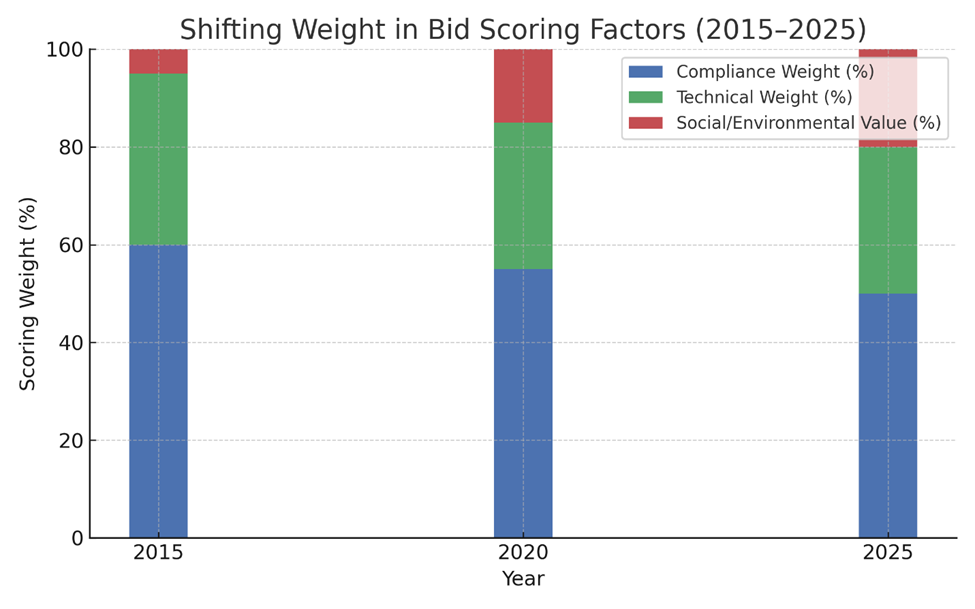
Procurement frameworks now weigh social and environmental impact, not just technical capability and price. Scoring rubrics have become more transparent and competitive, often rewarding teams that can tell a clear, evidence-driven story.
Meanwhile, buyers are flooded with bid tender writer proposals. They look for clarity, relevance, and measurable results—not generic promises. At the same time, organizations must respond faster to more tenders while keeping costs down.
This is why bid writing needs a new playbook: one that combines
- Score-driven strategy (building responses around the evaluation rubric),
- Compliance precision (to avoid disqualification),
- Proof density (hard metrics, certifications, and case studies in every section), and
- AI-enabled efficiency (to draft faster without sacrificing accuracy).
The future of successful writing a bid for a contract belongs to teams that can adapt to these expectations and turn their proposals into structured, scoring machines—not just well-written documents.
Start with “Score Engineering”: Reverse-Design Your Bid from the Rubric
Most bid writing companies talk about “meeting requirements.” Winners engineer their proposal from the scoring model.
Map the Scoring Model (Mandatory vs. Weighted)
Before you draft, analyze the buyer’s evaluation criteria. Break down mandatory vs. weighted components—e.g., 30% technical, 20% social/environmental value, 20% price.
Build a “points-per-paragraph” worksheet so every line of your bid writing contributes to your score.
In many government frameworks, social value alone accounts for 10–20% of marks (as noted by ProQsmart). Ignoring it is leaving points on the table.
Win-Themes & Proof Density
Successful bid and proposal writing threads 3–5 consistent win-themes (e.g., risk reduction, innovation, local impact) throughout all sections.
Follow the proof density rule: aim for at least one specific evidence item (case study, KPI, certificate) every 75–100 words. Evaluators reward tangible proof, not promises.
Download the Free Toolkit Now – start scoring higher in your next tender.
The Shift in Bid Writing Expectations
| Aspect | Old Approach (Pre-2020) | New Playbook (Current & Future) |
| Strategy | Focused on just meeting basic requirements | Built around scoring criteria and win-themes |
| Compliance | Checked near submission deadline | Continuous compliance tracking using matrices & tools |
| Evidence & Proof | Light use of generic claims | High proof-density with metrics, certifications, KPIs |
| Social & Environmental Value | Rarely considered | Weighted up to 10-20% in many public tenders |
| Storytelling | Generic boilerplate paragraphs | Buyer-centric storytelling with measurable outcomes |
| Technology & Tools | Manual, document-heavy | AI-enabled drafting & compliance linting |
| Speed & Efficiency | Weeks of manual effort | Faster AI + template workflows for higher volume |
| Evaluator Expectation | Willing to read long text | Prefer clear, concise, score-focused answers |
The Bid/No-Bid Gate: When Saying “No” Wins Later
Qualification Checklist
Top bid writing agencies and bid writing consultants use a structured gate to decide if a tender is worth pursuing:
- Strategic fit
- Resource capacity
- Past performance relevance
- Pricing power
- Incumbent advantage/risk
Opportunity Cost Math
Every bid consumes time and budget. Calculate expected value versus resource burn, then maintain a balanced pipeline.
Build the Compliance Core So You Don’t Auto-Lose
Most competitors talk about tender documentation; few show you how to operationalize it.
Compliance Matrix (Downloadable)
Create a live compliance matrix with these columns:
- Requirement ID
- Response page/paragraph
- Evidence provided
- Owner
- Status
Link it to version control and red/gold team review gates (a proven Hinz Consulting method).
You can also download this Bid Writing Toolkit.
“Answer Anatomy” Template
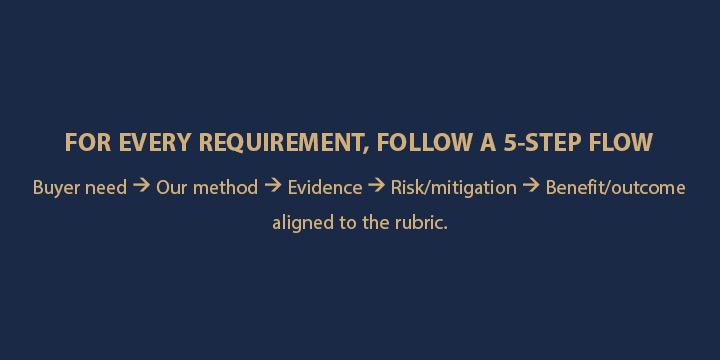
For every requirement, follow a 5-step flow:
Buyer need → Our method → Evidence → Risk/mitigation → Benefit/outcome aligned to the rubric.
Note: Proposals longer than 15% over the page limit often suffer from lower engagement scores.
Write the Six Sections Evaluators Score First
Most tender writing companies focus on the same standard sections. Go deeper to gain a scoring edge.
- Executive Summary That Signals Certainty
Mirror buyer priorities such as cost efficiency, sustainability, and speed. Introduce 3 win-themes up front and back them with a 3-line value/impact mini-case (Tendium advocates for such buyer-centric messaging).
- Technical Approach (With Measurable Methods)
Use diagrams, tooling details, SLAs, KPIs, and quality-assurance standards like ISO. Show the “how” with evidence.
- Management Plan (People, Governance, Risk)
Include an org chart, RACI table, cadence of reviews, escalation paths, and a sample risk register (as often recommended by Hinz Consulting).
- Past Performance (Relevance + Quant)
Present 3 highly relevant case studies:
- Baseline challenge
- Intervention (your process)
- Outcome metrics (quantified gains)
- Pricing Strategy (Value Narrative + Compliance)
Offer transparent breakdowns, alternative packages, value-add services, and link each element to cost-control levers and compliance.
- Social/Environmental Value (Where Points Live Now)
Highlight local hiring, apprenticeships, SME supply-chain participation, and your carbon-reduction plan. ProQsmart notes evaluators now weigh such criteria heavily.
Master the Tender Q&A and Clarifications
A critical yet underused phase of the bid writing process.
Ask “Scoring” Questions
Clarify ambiguous requirements to uncover what evaluators truly prioritize. (Tendium stresses that asking early helps steer strategy.)
Log, Track, and Pivot
Keep a living Q&A log and adjust draft content as clarifications shift buyer priorities.
AI-Powered Bid Writing—Without Losing Accuracy
Competitors mention AI; you’ll win by providing a clear, responsible framework.
The 5-Stage AI Workflow
- Deconstruct the RFP → extract all requirements and scoring rules
- Draft Assist → AI creates a first pass using your historical bids and win-themes
- Fact-Check Sweep → human SMEs verify each claim and attach citations or screenshots
- Compliance Linting → AI flags gaps vs. the compliance matrix to prevent omissions or hallucinations
- Tone & Clarity Polish → plain-language editing to remove jargon
Prompt Patterns (Brief Examples)
Prompt:
“Given these requirements [paste IDs], propose a 200-word answer hitting evidence X/Y/Z and conclude with a buyer-aligned benefit tied to criterion 3.1.”
Prompt:
You are an experienced professional bid writer preparing a response for a competitive tender.
Your goal is to produce a compelling, buyer-centric answer that is compliant, persuasive, and scoring-optimized.
Input:
- Tender requirement / question: [PASTE THE REQUIREMENT HERE]
- Buyer’s stated priorities (e.g., cost-effectiveness, sustainability, innovation): [PASTE OR LIST THEM]
- Available evidence and proof points (e.g., certifications, case studies, metrics, client testimonials): [LIST THEM]
- Target word count: [E.G., 200–250 WORDS]
- Evaluation criterion (e.g., Criterion 3.1 or Social Value): [SPECIFY]
Task:
- Start with a clear buyer-focused opening line that reflects the requirement’s purpose.
- Present a structured, step-by-step explanation of our approach that addresses the buyer’s needs.
- Integrate all proof points naturally to establish credibility (e.g., measurable results, certifications, KPIs).
- Use plain, professional, and confident language—no jargon or fluff.
- Conclude with a short, high-impact benefit statement that ties the response directly to the stated evaluation criterion.
- Ensure every paragraph contributes to earning evaluation points (score-focused writing).
Output should be concise, persuasive, and evaluator-friendly, suitable for inclusion in a formal tender or RFP response.
Advanced Storyboarding and Page Architecture
Visual Hierarchy That Scores
Use sub-headlines mirroring rubric criteria and callouts for proof items. Establish a strong visual hierarchy with 2D/3D renders that guide evaluators through your proposal, making complex information easier to understand and visually engaging.
Reusable Modules
Keep templates for SLA cards, KPI tables, risk-mitigation banners, and local-impact tiles to accelerate future bids.
Reviews That Actually Improve Scores (Red → Gold)
Red Team
Challenges strategy, differentiation, and proof density.
Gold Team
Final compliance and language check.
“Score Rehearsal”
Run internal mock scoring using the evaluator’s rubric (a best practice emphasized by Hinz Consulting).
Price-to-Score Tradeoffs & BAFO Readiness
Scenario Matrix
Anticipate how much score you can concede on price versus quality and still win.
Negotiation Prep
Pre-plan variant pricing options and acceptable concessions for the Best and Final Offer (BAFO) stage.
Sector Variations (Public vs. Private vs. Grants)
Public Procurement
High compliance weighting, social-value commitments, transparency record. (ProQsmart notes social value can be decisive.)
Private RFPs
Faster cycles, proof-of-concept pilots, greater emphasis on commercial flexibility.
Grants & Nonprofits
Focus on measurable outcomes, theories of change, and alignment with funder missions (highlighted by Craigmyle).
After-Action: Analytics and Continuous Win-Rate Uplift
KPI Dashboard
Track win rate by buyer, score variance by section, proof density vs. score, and review cycle efficiency.
Lessons-Learned Cadence
Feed post-mortem insights into a growing library of validated snippets for reuse.
Conclusion: From Compliance to Competitive Advantage
Winning today’s bids isn’t about luck — it’s about mastering the bid writing process with strategy, precision, and tools that help you score higher than competitors.
By reverse-engineering your proposal from the evaluator’s rubric, using proof-driven answers, leveraging AI responsibly, and applying disciplined reviews, you turn each bid into a structured path to success.
Whether you handle tenders in-house or work with professional bid writers or tender writing services, focusing on score engineering, compliance, and continuous improvement can transform bid writing from a routine task into a repeatable competitive advantage.
Contact cesol today for bid writing services taking care of all your bid writing process and solutions.
Frequently Asked Questions
Writing a bid proposal is the structured process of creating an especially expert RFP and tender responses—that comply with requirements and maximize scoring.
Bid writers focus on crafting compliant, persuasive answers; proposal managers orchestrate timelines, reviews, and cross-functional input.
Many firms use hybrid models, professional construction bid writer for complex tenders and internal teams for repeatable responses.
Benchmarks vary by sector: 30–40% for open competitive procurement is strong; framework mini-competitions often go higher with incumbency.
Yes, if you follow a governed workflow with human fact-checking and compliance checks, as advised by experts like Tendium.