
Ever wondered why some contractors win projects effortlessly while others struggle despite competitive bids? The secret often lies in one thing: tender documentation. But what exactly is it, why does it matter, and how can you prepare it to stand out from the competition? Now, many professionals still ask: What is tender documentation, why is it important, and how do you prepare it correctly?
This complete guide to tender documentation explained in simple words, will help you to know, tender documentation importance, its components, and tender documentation requirements, to real-world examples, mistakes to avoid, and step-by-step preparation.
What is a Tender Document in Construction?
At its core, tender documentation is a set of structured documents that outline a contractor’s offer to deliver a project at a specific cost, within defined timelines, and under stated conditions.
In simple words:
A tender document is an offer by a contractor to a client explaining how the contractor intends to execute the work, the cost at which it will be executed, and the terms. It is a kind of official communication channel between a contractor and the project owner, hence making the documents in the tendering process essential in competition, equality, and success in the completion of projects.
Why are Tender Documents Important?
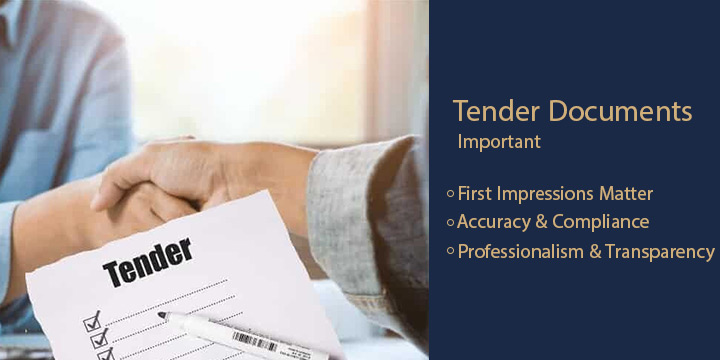
It is essential to understand the importance of tender documentation, though it involves more paperwork, it is important in project winning:
- First Impressions Matter: A professional tender makes you reliable and assures the client of your awareness of their needs.
- Accuracy & Compliance: Correct estimates and compliance reduce rejection risks.
- Professionalism & Transparency: Clear documents make evaluation easier and set the tone for smooth collaboration.
Key Components of Tender Documents
While the tender documentation process may vary by project, most types of tender documents include the following:
1. Invitation to Tender (ITT)
A formal request issued by the client inviting contractors to submit bids. It usually includes project scope, submission deadlines, and evaluation criteria.
2. Instructions to Tenderers
Detailed guidelines on how contractors should prepare, format, and submit their tenders. This reduces confusion and ensures uniformity among submissions.
3. Tender Submission Form
A standardized form where contractors formally submit their offer, often requiring signatures to confirm compliance with project requirements.
4. Project Information
This area gives specific, followed descriptions and specifications, drawings and any desirable background information. It makes the bidders aware of the extent to be undertaken.
5. Contract Conditions
The legal backbone of the tender. Those terms and conditions, payment arrangements, liabilities, risk transfers, and how disputes shall be handled are defined in it. It outlines terms and conditions, payment schedules, liabilities, risk allocation, and dispute resolution processes.
6. Bidding Instructions
This section specifies pricing structures, unit rates, taxes, and inclusions. Clear bidding instructions avoid ambiguity and allow fair evaluation.
Together, these documents form the tender documentation requirements and tender documents list, contractors must meet.
Types of Tender Documents
In construction and project procurement, tender documentation comes in different forms depending on the project requirements, level of detail, and the procurement method chosen. The types of tender documents that are most common are presented below:
1. Open Tender Document
An open-tender document enables the participation of all deserving contractors, hence, frequently with a government or a publicly announced project. It favours openness, broad involvement, and more competitive pricing.
2. Selective Tender Document
A selective tender document is issued only to pre-qualified contractors chosen by the client. It is typically used for specialized projects that demand proven expertise, a strong reputation, or financial capacity. This approach saves time and ensures that only capable and reliable bidders are considered.
3. Negotiated Tender Document
A negotiated tender document is prepared for direct negotiation with one or a small number of contractors. It is often used for highly technical or urgent projects, or when a contractor has prior proven experience with the client. This method speeds up the process, making it ideal for projects with strict deadlines.
4. Single-Stage Tender Document
A single-stage tender document provides all technical and financial project information at once, requiring bidders to submit a complete tender in a single package. It is best suited for straightforward projects with clear requirements and offers the advantage of a simple process with quick evaluation.
5. Two-Stage Tender Document
A two-stage tender document separates the process into two parts: the first stage focuses on technical proposals, including skills, methodology, and capability, while the second stage invites shortlisted contractors to submit financial bids. This method is ideal for complex projects where design and innovation are critical, ensuring quality selection before cost discussions.
6. Term Tender Document
A term tender document covers a fixed duration, usually between one and three years, during which the contractor provides ongoing works or services under agreed terms. Commonly used for maintenance, facility management, or recurring services, it offers both stability and predictable long-term costs.
7. Framework Tender Document
A framework tender document is created when multiple projects are expected over several years. It establishes a framework agreement with selected contractors, allowing future projects to be awarded without re-tendering. This approach is especially useful for governments or large organizations and helps save both time and money.
Example of a Construction Tender Document
To better understand, let’s look at a tender documentation in construction example from a typical construction project:
- Invitation to Tender (ITT): Issued by a government agency for road construction.
- Instructions: State submission deadline (e.g., 30 days), required formats, and number of copies.
- Submission Form: Includes contractor details, pricing, and signatures.
- Project Information: Road length, design drawings, soil conditions, and environmental considerations.
- Contract Conditions: Payment milestones (20% advance, 30% mid-project, 50% completion).
- Bidding Instructions: Specific unit costs for asphalt, labor, and equipment.
The given walkthrough emphasizes the role of tender documentation to make all sides have a clear idea of what will happen before the work actually commences.
How to Prepare Tender Documentation (Step-by-Step)
Preparing tender documentation for projects requires accuracy and a structured approach. Here’s a step-by-step guide:
Step 1: Gather Project Details
Collect drawings, designs, client requirements, and site conditions. Missing details at this stage can lead to flawed cost estimations.
Step 2: Do Quantity Takeoff & Estimation
Conduct a detailed quantity takeoff (QTO) to measure materials, labor, and equipment. Prepare a realistic cost estimate that balances competitiveness with profitability.
Step 3: Draft Key Sections
Write each component: ITT response, submission form, project methodology, and pricing sheets. Ensure compliance with tender documentation guidelines provided by the client.
Step 4: Review Compliance & Legal Aspects
Check contracts, certifications, licenses, and insurance requirements. Non-compliance is one of the biggest reasons tenders are rejected.
Step 5: Submit Professionally
Format documents clearly, bind them neatly, and ensure digital submissions are error-free. Timeliness and presentation add credibility.
Tips for Preparing Tender Submissions
It takes more than form-filling to prepare a decent tender submission. The contractors need to strike a balance between accuracy, competitiveness, and professionalism in order to be unique. These are some of the vital tips:
- Read the tender documentation carefully – Read everything about what is needed, contingent, and directed before writing yours.
- Provide complete and accurate information – Make sure that certificates, licenses, and supportive documentation are attached and updated.
- Focus on cost accuracy – Avoid over-bidding or under-bidding by use of realistic pricing and detailed estimates.
- Highlight your strengths – Present case studies, and technically relevant experience, or other things that show that you can.
- Maintain clear and professional formatting –Use organized sections, non-written errors, and presentation.
- Double-check compliance – Make sure to review legal, safety, and regulatory requirements before submission.
- Submit before the deadline – Submission late in the day will almost always be disqualified, even at the merit end of it.
- Review thoroughly – Proofread, cross-check figures, and ensure the final tender is error-free and complete.
Following these tender submission tips helps contractors create proposals that are competitive, professional, and more likely to win projects.
Common Mistakes to Avoid in Tendering
Even seasoned contractors make mistakes during the tender documentation process. Here are the most common ones:
1. Missing Deadlines
Late submission almost always leads to disqualification, regardless of document quality.
2. Incomplete Information
Forgetting key certificates, licenses, or pricing sheets can weaken your proposal.
3. Poor Cost Estimation
Being over- or under-pessimistic in the costs can cause your tender to be neither competitive nor profitable. Preventing these mistakes will give you a great opportunity to win.
Conclusion
Tender documentation in construction or other sectors is not reducible to forms when it is used to win a project. It shows how professionally, correctly and how well you can satisfy the needs of clients. By learning to develop the tender documents, the contractors get a competitive advantage, evade the expensive errors, and establish better relationships with clients. Suffice to say that the usefulness of tender documentation should not be understated; it is your map to project success. Prepare flawless tender documents effortlessly with CESOL – get started today!
FAQs
Tender documents are typically prepared by the client or consultant, while contractors prepare tender submission documents as a response.
The primary objective of making a tender document is to have transparency, fairness, and clarity in the bidding process. It provides parity in the distribution of information pertaining to the project to all prospective contractors and enables the client to set standards on the evaluation of the submissions and eventually identify the most appropriate contractor.
It creates transparency and fairness towards the procurement process and accuracy, besides providing the contractors with a formality in presenting their offers.
Contractors typically prepare only the submission documents. However, in design-build or private projects, they may also draft parts of the tender documentation in collaboration with the client.
The time varies depending on project complexity. Small tenders may take a few days, while large or technical projects can take several weeks to prepare