
In Australia’s fast-moving building industry, even a small mistake in construction takeoff can snowball into blown budgets, lost time, and frustrated clients. Yet construction takeoff errors and construction estimating errors still rank among the top causes of project overruns. From errors in material takeoff to hidden construction quantity takeoff mistakes, the consequences are costly but preventable.
In this guide we will uncover the common errors in construction takeoff and construction estimating errors we see every week, explain the inaccurate construction takeoff consequences, and show how to avoid errors in construction takeoff with a simple, repeatable workflow.
Whether you’re still doing manual takeoffs or you’ve gone digital, this article shows you how to boost construction takeoff accuracy, reduce construction bid takeoff errors, and protect your margins. Ready to improve your numbers? Let’s dive in.
Why Accurate Takeoffs Matter in Australia
Material costs and labor rates are volatile in Australia. A small misstep in a construction quantity takeoff can quickly turn into a big cost overrun. Local studies show that errors in estimates cause up to 9% waste on residential projects. That’s why every builder needs a process that delivers real construction takeoff accuracy and quality control.
Even one big mistake in construction takeoff can wipe out your project margin. Miss a few square meters of tiling or underestimate labor hours and suddenly you’re burning through cash and time.
The 12 Most Common Mistakes and how to avoid errors in construction takeoff?
Even experienced builders and estimators can fall into the same traps during a takeoff. From construction quantity takeoff mistakes to construction cost estimating errors, these missteps can quickly erode profits. Below we’ve listed the 12 most common construction takeoff errors we see in Australian projects — and, more importantly, the simple fixes you can implement today to improve construction takeoff accuracy and prevent expensive overruns.
1. Using Outdated Drawings (classic construction takeoff errors)
Problem: Many estimators still print drawings or download PDFs and never check if they’re the latest revision. This leads to immediate mistakes in construction takeoff.
Consequences: Ordering materials off old specs often causes rework, wasted time, and construction cost estimating errors.
Fix:
- Always confirm drawing version with architect/engineer.
- Keep a central folder with “current” and “superseded” labels.
- Stamp or watermark your working set “Rev B” or “Latest Issue” to avoid confusion.
Pro Tip: Build a 2-minute “version check” into your construction takeoff quality control checklist before you start measuring.
2. Mis-calibrated Digital Scales (a digital construction takeoff mistake)
Problem: With PDF plans, one wrong calibration of the scale tool can create a 10% quantity error.
Consequences: Digital tools promise precision, but miscalibration produces worse results than manual. That’s why manual takeoff vs digital takeoff errors must be managed.
Fix:
- Calibrate each plan separately.
- Double-check dimensions on a known element (door width, gridline).
- Use software that enforces calibration before measuring.
Pro Tip: Add a “calibration check” box to your template; a colleague must initial it before you proceed.
3. Inaccurate Material Quantities (common construction takeoff problems)
Problem: Even with good software, human error can creep in: missed rooms, double counting, or copy-pasting wrong formulas.
Consequences: Shortages trigger urgent deliveries and idle crews — the worst inaccurate construction takeoff consequences.
Fix:
- Break down takeoff by trade or area.
- Use color-coded highlights to show completed sections.
- Peer review quantities before ordering.
4. Forgetting Waste Allowances (quantity surveying errors)
Problem: Some estimators don’t include waste at all; others add arbitrary percentages.
Consequences: Either your under-order and stall, or over-order and blow cash on excess stock.
Fix:
- Use standard waste factors by material (tiles 10%, framing timber 5%).
- Record the factor in your template for transparency.
Pro Tip: After each job, update your waste factors based on actual usage to improve construction takeoff accuracy.
5. Underestimating Labour & Productivity (estimating takeoff errors in construction projects)
Problem: Labour hours are often guessed rather than calculated from crew productivity rates.
Consequences: This leads to underpriced bids and construction bid takeoff errors that crush your profit.
Fix:
- Build a simple productivity database (e.g., square meters per day per crew).
- Adjust rates for site complexity and weather.
Pro Tip: In Australia, check regional labour award rates before pricing — a hidden but common source of construction estimating errors.
6. Ignoring Indirects & Overheads (construction cost estimating errors)
Problem: Estimators sometimes include only direct materials and labor.
Consequences: Equipment hire, supervision, compliance costs, and admin disappear from the budget — but not from reality.
Fix:
- Add an “Indirects” section in every takeoff sheet.
- Use historical percentages to estimate site costs.
Pro Tip: Have a senior team member review your indirect before finalizing any estimate to avoid hidden errors in material takeoff.
7. Not Updating Takeoffs After Changes (a manual takeoff vs digital takeoff error)
Problem: A spec change or RFI arrives but never gets reflected in the takeoff.
Consequences: Your order list is now wrong — a top cause of construction takeoff errors.
Fix:
- Create a change log.
- Only one person updates the master takeoff.
- Highlight changed cells in your spreadsheet.
Pro Tip: Schedule a weekly “change review” on live projects to keep your takeoff current.
8. Blind Reliance on Software (another digital construction takeoff mistake)
Problem: Software automates measuring, but it can’t interpret ambiguous drawings.
Consequences: Over-trusting automation leads to costly construction estimating errors.
Fix:
- Train staff to question anomalies.
- Cross-check key quantities manually.
Pro Tip: Combine digital with manual spot checks to cut both manual takeoff vs digital takeoff errors.
9. Poor Documentation & Record Keeping (repeat mistakes in construction takeoff)
Problem: Takeoffs saved on personal drives or emailed spreadsheets get lost.
Consequences: No audit trail, repeat work, and disputes with suppliers.
Fix:
- Use cloud storage with version history.
- Assign a naming convention.
Pro Tip: Build a central “takeoff library” — improves institutional memory and construction takeoff quality control.
10. Overlooking Site Conditions & Deliverability (construction takeoff problems)
Problem: Drawings don’t always show real-world obstacles: restricted access, slopes, or weather exposure.
Consequences: You underestimate handling or waste, creating hidden construction cost estimating errors.
Fix:
- Conduct a pre-site survey or drone scan.
- Add allowances for handling and staging.
Pro Tip: Include a “site check” photo in your takeoff file to remind the team of conditions.
11. Poorly Structured Takeoff Sheets (construction quantity takeoff mistakes)
Problem: Mixed categories, inconsistent units and unlabeled columns create confusion.
Consequences: This leads to duplicate orders and construction bid takeoff errors.
Fix:
- Standardize categories and units.
- Use filters and layers.
12. No Historical Data or Post-Job Review (inaccurate construction takeoff consequences)
Problem: If you never compare estimated vs actual, you repeat the same errors in material takeoff.
Consequences: Chronic underbidding or waste.
Fix:
- After each job, review quantities and costs.
- Update your database.
Pro Tip: Hold a “lessons learned” meeting after every project to refine your process.
Manual vs Digital Takeoffs: Where Each Fails
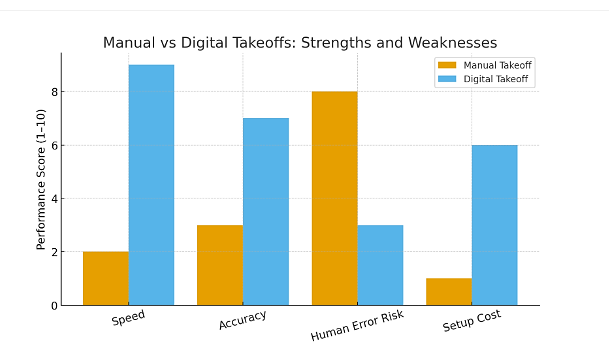
In reality, manual takeoff vs digital takeoff errors both exist avoiding Common Mistakes in Material Takeoff Manual is prone to arithmetic mistakes but forces you to look closely at drawings. Digital is fast but can multiply small setup errors across hundreds of items. The best practice is hybrid: digital measurement plus manual spot checks plus peer review — a true construction takeoff quality control workflow.
FACT: Builders using digital takeoff tools report up to an 80% reduction in takeoff time compared to manual methods, according to Buildxact AU.
Real-World Case Study as a construction takeoff example
A Melbourne builder came to us after repeated construction estimating errors and construction quantity takeoff mistakes. We ran a free audit on one project, found a 7% miscount in concrete volumes and unpriced crane hire. After implementing our workflow, they cut material waste by 12% and improved bid accuracy on the next job — avoiding the kind of inaccurate construction takeoff consequences that were eating their margin.
A Quick Checklist: 10 Things to Do Before Ordering Materials
- Confirm latest drawing version.
- Calibrate scale.
- Add waste allowance.
- Include indirects.
- Peer sign-off.
- Pre-site survey.
- Use structured template.
- Capture RFI changes.
- Save signed copy.
- Review historical data.
This checklist is designed to stop construction takeoff problems and quantity surveying errors before they occur.
Conclusion:
Accurate takeoffs aren’t just a technical exercise—they’re the foundation of profitable, stress-free projects. By recognizing and eliminating the most common mistakes in construction takeoff, you can slash overruns, improve construction cost estimating accuracy, and deliver on time and on budget.
The good news? Every error outlined above—from digital construction takeoff mistakes to manual takeoff vs digital takeoff errors—can be controlled with the right process. Using clear checklists, supplier-linked software, and peer reviews will dramatically cut estimating takeoff errors in construction projects and keep your clients’ trust.
Ready to see where you’re losing money? Book your Free Takeoff Audit today. We’ll review one plan and show exactly where you’re making mistakes in construction takeoff, construction quantity takeoff mistakes, or suffering from construction bid takeoff errors — before you order materials.
Book Your Free Audit Now and Visit our website cesol today!
FAQs
Typically 1–2 days. Our process reduces construction takeoff errors even on tight deadlines.
Yes — faster pricing and fewer construction cost estimating errors are challenges in construction takeoff services.
5–10% depending on material. This simple step stops many mistakes in construction takeoff.
Yes — we offer a free 30-minute audit to uncover big mistakes in construction takeoff and construction estimating errors.
Yes — our service helps reduce estimating takeoff errors in construction projects across Australia.