
Have you ever think how contractors accurately estimate the materials and costs needed for a construction project before laying the first brick? The secret lies in a construction takeoff—a critical process that helps contractors, estimators, and project managers plan efficiently, reduce construction takeoff errors, and prepare precise bids.
So in this guide, we will be looking at what construction takeoffs are, how they happen, the benefits, and tools involved in construction takeoff, so that you are well equipped with what it is in construction project planning.
What Is a Construction Take-Off?
A construction take off involves examining project blueprints and specifications in order to estimate all the materials, labor, and equipment required to carry out a construction project. Construction quantity takeoff is sometimes called, making it important to undertake meticulous measurement and listing of every single item needed to finish a job. Reliability in construction cost in an estimation of a project depends entirely on the accuracy of the construction takeoff.
In the absence of accurate takeoffs, estimators may end up under-estimating or over-estimating the materials requirements to a point that the budget may be exceeded, causing delays in the project completion or worse, loss of the contract.
Purpose of Construction TakeOff
The primary point of construction takeoff is to give an elaborate guide for project execution. It makes contractors efficiently plan their resources, eliminates cost escalation as well as error control, and takes into account the proper preparation of construction bids. Takeoffs make it possible to ensure that all the materials and tasks are factored during the construction project planning and scheduling, and hence, they are critical in the proper estimation of construction costs.
Types of Construction Take-Offs
Manual TakeOff
Manual takeoffs used to be made traditionally with the use of rulers, scales, calculators, and working paper plans. This approach implies taking some direct measurements based on the physical blueprint, estimating materials, and drawing up a comprehensive description of the necessary materials. Although they are effective, manual takeoffs tend to consume a lot of time, they are susceptible to human error, and updating manual takeoffs when changes are made to the project plans is very cumbersome.
Digital TakeOff
The digital takeoff or the use of the takeoff software in construction has enabled many estimators to automate the takeoff process in recent construction projects. Solutions such as stackCT, buildertrend, planswift, and bluebeam are used to import digital blueprints, measure the quantity of materials accurately, and automatically create material lists and cost estimates, which means the process is cheaper and quicker.
Advantages of Each Type
Manual Takeoff:
- Low cost and simple to implement.
- No software learning curve required.
- Suitable for small projects or teams new to construction quantity takeoff.
Digital Takeoff:
- Faster and more efficient than manual methods.
- Highly accurate measurements and reduced risk of errors.
- Scalable for larger projects and easy to update when plans change.
- Using takeoff software for construction helps streamline the construction estimating process and enhances construction project planning.
By integrating these approaches appropriately, contractors can save time, reduce mistakes, and produce more competitive bids worldwide.
Step-by-Step Construction Take-Off Process
Understanding the construction takeoff process is crucial for both beginners and seasoned professionals. Here’s a structured approach:
Step 1 – Review Project Plans
The step that should be taken in the construction takeoff is to look at all the project blueprints and design documents, consisting of architectural, structural, and MEP plans. This close check would achieve accurate construction quantity take off, and it will assist the contractor in drawing close material lists and cost estimates towards successful planning of construction projects.
Step 2 – Identify Materials & Quantities
Afterwards, estimators determine all the materials needed in each component of the project, such as concrete, steel, masonry, electrical /wiring and fixtures, plumbing materials, and flooring/finish materials, among others. When properly measured at this stage, there is an accurate take-off of construction materials and ensures that they reduce wastages.
Step 3 – Organize Material Lists
After the quantities of materials have been established, they ought to be well-systematized. This will entail sorting the items into types of materials or parts of the project, and mentioning the unit measures for the items, whether in cubic meters, linear meters or pieces and creating a master material list that will make procurement to be done easier and also help in the planning of the construction project.
Step 4 – Estimate Costs
Once the quantities of material have been compiled, cost calculations are to be followed. Unit costs of every material are estimated by estimators, and they include labor, transport costs, and costs of equipment. The totaling of these costs gives the detailed estimate of the project which becomes important in accurate estimation of construction costs and preparation of successful construction bids.
Step 5 – Cross-Check & Validate
The last is to audit all the calculations to make them accurate. Estimators ascertain that nothing is lacking, and the quantities are arranged according to the project plans, and the cost estimation includes the market prices. Most construction contractors prefer using takeoff construction software to automate this validation to help minimize errors and ensure accurate construction material takeoff.
Benefits of Construction TakeOff
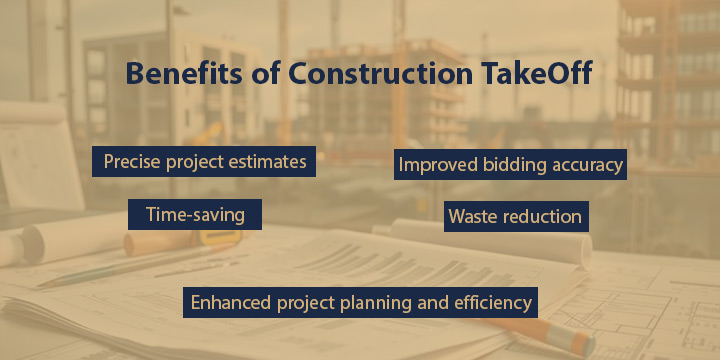
Accurate takeoffs offer numerous benefits for construction projects:
- Precise project estimates: Avoid budget overruns and underestimation.
- Time-saving: Streamlines project planning and reduces manual calculations.
- Waste reduction: Ensures correct material ordering.
- Improved bidding accuracy: Higher chance of winning contracts.
- Enhanced project planning and efficiency: Provides clear insights for scheduling and resource allocation.
In addition, modern digital tools help teams adapt quickly to design changes, making takeoffs even more valuable for dynamic construction environments.
Common Challenges in Construction TakeOff
Despite its importance, construction takeoffs come with challenges:
- Errors in measurement: Manual mistakes can skew quantity estimates.
- Outdated or unclear blueprints: Inaccurate or incomplete plans complicate estimation.
- Manual calculation mistakes: Hand calculations increase the risk of human error.
Mitigation strategies include adopting digital takeoff tools, training staff on accurate takeoff techniques, and performing cross-checks throughout the process.
Tools & Software for Construction TakeOff

Several globally recognized tools help streamline takeoffs:
- StackCT: Cloud-based platform for collaborative takeoffs.
- Buildertrend: Integrates takeoffs with project management and cost tracking.
- PlanSwift: Offers precise digital measurements for estimating materials.
- Bluebeam Revu: Advanced PDF-based takeoff solution for construction professionals.
Compared to manual methods, these tools significantly improve speed, accuracy, and efficiency, making them ideal for modern construction projects.
Tips for Accurate Construction TakeOff
To ensure reliability in your takeoff process, consider these tips:
- Double-check measurements: Always validate quantities for accuracy.
- Use standardized units: Maintain consistency across all estimates.
- Leverage software: Employ construction takeoff software for speed and precision.
- Train your team: Skilled estimators reduce mistakes and improve overall project accuracy.
Implementing these practices helps achieve precise construction quantity takeoff service and reliable construction cost estimation.
Conclusion
A construction takeoff is the vital part of construction project completion. It gives background to proper cost estimation, project planning, and competitive bid making. Taking into account the process of construction takeoff, adopting digital solutions, and implementing correct methodologies, project managers and contractors will be able to improve the process within the shortest time possible, decrease the expenses, and facilitate the project’s success.
Streamline your construction estimates with CESOL – start your takeoff now!
FAQs
It involves the quantification of the project blueprints. It keeps the estimated cost correct, minimizes errors, and aids proper project planning.
Examine project plans, find materials and quantities, make lists, make cost estimates, and compare all information with the accurate one.
Some of the well-known tools include StackCT, Buildertrend, PlanSwift, and the amazing Bluebeam Revu for crisp and efficient digital takeoffs.
Yes, proper take offs will avoid over-ordering, wastage of materials as well as better accuracy of bids, and this leads to cost reductions.
Causes are measurement errors, old blueprints, manual calculation errors; they can be reduced by digital take-off and adequate training.