
Winning tenders isn’t about being the cheapest bidder; it’s about being the most accurate, compliant, and trustworthy. Too often, projects are lost due to tender preparation mistakes, not because of a lack of ability. These are the common mistakes in tender preparation that even experienced firms often make: missing documents, incorrect pricing structures, vague scopes, or non-compliant formats. These small slip-ups lead to rejection and lost credibility.
The reality is that the importance of tender accuracy cannot be overstated. Mistakes that are usually made by tenderers in submitting this form of tender directly affect win rates. To consistently secure projects, contractors must master effective tender preparation strategies, use a tender preparation checklist, and avoid the typical tender submission mistakes that evaluators see daily.
What is the Construction Tendering Process
Before we dive into errors, it’s critical to understand the construction tendering process itself. A tender is more than just a quote; it’s a structured competition where clients evaluate compliance, cost, risk, and methodology through a defined tender evaluation process.
Every stage presents risks. For example, a missing scope detail during pre-tender can cause disputes later. Failing to answer clarifications creates doubt. And submitting late or incomplete proposals are tender submission mistakes that lead to instant rejection. Knowing where these pitfalls are is the first step in solving them.
Key Stages of the Tendering Process
| Stage | Client’s Role | Tenderer’s Role | Common Errors Made by Tenderers |
| Pre-Tender | Define scope, issue requirements | Analyse documents, site visits, and plan risks | Misreading documents, unclear assumptions |
| Selection | Provide clarifications | Prepare cost breakdown, review drawings | Ignoring clarifications, rushed pricing |
| Submission | Accept bids | Submit final proposal with pricing & documents | Late submission, missing attachments |
| Evaluation & Award | Score bids, shortlist firms | Respond to queries, defend pricing & approach | Generic answers, errors in tender documentation |
| Contract Finalisation | Sign agreement, set milestones | Mobilise team, finalise deliverables | Legal oversights, vague Scope of Work |
The Four Pillars of Tender Failure
Many tenders fail not because of capability, but due to avoidable errors; missed deadlines, incomplete documents, ignoring selection criteria, unclear pricing, poor formatting, or a weak grasp of client needs. The fix is simple: read documents carefully, build a requirement checklist, set early internal deadlines, research the client, write clear responses, get the bid reviewed, and use a compliance matrix to stay on track.
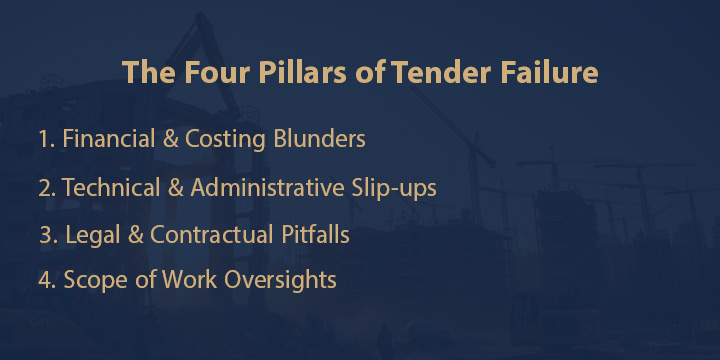
1. Financial & Costing Blunders
Money mistakes are the fastest way to lose credibility. Many tenderers attempt to win projects by underpricing, often ignoring indirect costs such as insurance, administration, or permits. Others overlook market volatility, forgetting that material and labour prices can rise sharply during the project. Some even submit unbalanced bids, inflating certain items while underpricing others, a dangerous strategy that evaluators often flag.
To avoid these bidding mistakes to avoid, focus on total project costing and risk management:
- Always prepare a detailed cost breakdown that includes overheads, indirects, and contingency.
- Regularly update supplier quotes and account for escalation.
- Check for unbalanced items before submission; unit rates must be fair and transparent.
- Maintain a risk register to track threats and mitigation.
2. Technical & Administrative Slip-ups
Administrative oversights are among the most common reasons for rejection. These include missing attachments, wrong file formats, and late uploads. Even worse, many tenderers rely on generic templates instead of tailoring responses to the client’s needs. Evaluators see through this instantly, marking such submissions low.
To prevent these tender submission mistakes, build a compliance-driven culture:
- Use a compliance matrix to ensure every instruction is followed.
- Assign a final review team to double-check forms, attachments, and formatting.
- Write bespoke answers that directly reflect the client’s evaluation criteria.
- Avoid ambiguous wording, clarity reduces the risk of disputes.
3. Legal & Contractual Pitfalls
Contracts are full of hidden traps. A vague Scope of Work leads to future disputes because each party interprets it differently. Missing legal clauses on payments, disputes, and change orders exposes you to major risks. In some tenders, even the process itself creates legal obligations before the main contract is signed.
Avoid these tender preparation mistakes by making legal diligence part of your strategy:
- Draft a Scope of Work that clearly defines deliverables, milestones, and exclusions.
- Insert essential clauses for payments, changes, and dispute resolution.
- Review all documents against local legal requirements before submission.
- Remember: accuracy here helps in avoiding tender rejection at the contract stage.
4. Scope of Work Oversights
The Scope of Work (SOW) is often where errors in tender documentation are most visible. Many tenderers fail to structure their SOW properly or forget to involve key stakeholders during preparation. This results in inconsistent bids, cost gaps, and disputes once the project begins.
A clear scope prevents these common mistakes in tender preparation:
- Structure the scope using industry formats like CSI divisions.
- Hold early workshops with estimators, subcontractors, and designers.
- Document assumptions and exclusions clearly.
- Align scope with pricing to ensure consistency.
Effective Tender Preparation Strategies
Every winning contractor uses a combination of discipline, smart writing, and technology. These tender writing tips and tender preparation guidelines help transform your process from reactive to proactive.
Tender Writing Tips
Strong writing makes it easy for evaluators to award you points. Avoid fluff and focus on relevance:
- Align your responses with the buyer’s stated goals.
- Use past project examples with measurable outcomes.
- Mirror the evaluation criteria in your structure and headings.
- Keep wording clear, avoid jargon and overcomplication.
Tender Preparation Guidelines
Guidelines are your safety net. They ensure you don’t miss critical elements during preparation:
- Break the process into pre-tender analysis, draft writing, compliance checks, and submission.
- Use a compliance matrix that maps each requirement to the document section.
- Assign clear roles for pricing, content drafting, and final checks.
- Track clarifications and integrate answers into your submission.
Tender Preparation Checklist
| Step | Action | Mistakes Prevented |
| Pre-Tender | Review documents, clarify scope, visit site | Misreading requirements, weak assumptions |
| Drafting Phase | Prepare cost breakdown, tailor content, and draft method statements | Generic content, inaccurate pricing |
| Compliance Check | Check attachments, format, deadlines, and word counts | Tender submission mistakes, rejection |
| Final Review | Cross-check compliance matrix, senior sign-off | Errors in tender documentation |
| Post-Submission | Prepare clarifications, maintain version control of documents | Missed clarifications, confusion |
Tender Process Challenges and Solutions
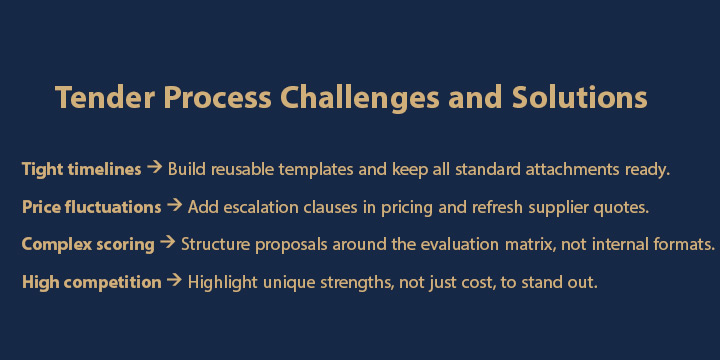
Every tender presents obstacles, but each has a solution.
Before the bullets, let’s set the scene: contractors often complain about tight timelines, sudden price hikes, or overly complex evaluations. These tender process challenges and solutions are not excuses for failure; they are reminders that preparation is about discipline, not luck.
- Tight timelines → Build reusable templates and keep all standard attachments ready.
- Price fluctuations → Add escalation clauses in pricing and refresh supplier quotes.
- Complex scoring → Structure proposals around the evaluation matrix, not internal formats.
- High competition → Highlight unique strengths, not just cost, to stand out.
Example of a Winning Tender Submission
Cover Letter (Client-Focused Introduction)
To: XYZ Infrastructure Authority
Project: Construction of New Community Sports Complex, Sydney
Dear Evaluation Committee,
Capstone Engineering Solutions (CESOL) is pleased to submit our tender for the Construction of the New Community Sports Complex. We have carefully reviewed your tender documents and requirements, and we are confident that our expertise in construction estimation, risk management, and project delivery makes us an ideal partner for this project.
Our approach focuses on accuracy, compliance, and transparency. We have provided a detailed cost estimate, project methodology, and delivery plan that aligns with your objectives. With a proven track record of delivering projects on time and within budget, we are committed to ensuring that this project is a success for both the Authority and the community.
Sincerely,
Project Director, CESOL
Executive Summary
- Project Understanding: Deliver a multi-purpose sports complex including indoor courts, outdoor fields, parking, and community facilities.
- Key Value: Accurate cost estimation with escalation protection, sustainable construction practices, and strong stakeholder engagement.
- Timeline: 14 months total, with staged milestones for early facility access.
- Commitment: Zero safety incidents, on-time completion, and transparent reporting.
Scope of Work (Clear & Structured)
Our proposed Scope of Work covers all client requirements:
- Site Preparation – clearing, grading, utility connections.
- Structural Works – foundations, steel framing, roofing.
- Facilities Construction – indoor courts, locker rooms, and meeting halls.
- External Works – parking, landscaping, lighting.
- Commissioning & Handover – safety certification, testing, final approvals.
Exclusions (for transparency): client-supplied furniture, IT systems, and ongoing facility management.
Methodology & Approach
We designed our approach around risk management, efficiency, and compliance:
- Planning & Mobilisation: A two-week mobilisation phase including site office setup and safety induction.
- Construction Delivery: Staged work packages with subcontractor coordination.
- Quality Assurance: Weekly inspections against ISO 9001 standards.
- Risk Control: Contingency allowances for cost fluctuations in steel and concrete.
- Client Communication: Weekly progress reports and monthly executive summaries.
Project Timeline
| Phase | Duration | Milestone |
| Site Preparation | 2 months | Utilities connected, site ready |
| Structural Works | 5 months | Frame completed, roof installed |
| Facilities Construction | 4 months | Courts, locker rooms, and interiors are complete |
| External Works | 2 months | Parking, landscaping, and lighting were installed |
| Commissioning & Handover | 1 month | Testing complete, facility handover |
Total Duration: 14 Months
Pricing & Cost Breakdown
| Item | Estimated Cost (AUD) | Notes |
| Site Preparation | $850,000 | Includes earthworks, utilities |
| Structural Works | $3,200,000 | Steel, roofing, and foundation works |
| Facilities Construction | $2,500,000 | Interiors, courts, HVAC, plumbing |
| External Works | $900,000 | Parking, landscaping, lighting |
| Commissioning & Handover | $250,000 | Final inspections and approvals |
| Total (Excl. GST) | $7,700,000 | Includes 5% contingency for price fluctuations |
Risk Management Strategy
- Material Price Fluctuations: Supplier-backed quotes and escalation clauses in place.
- Weather Delays: Buffer in scheduling, rapid response protocols.
- Safety Risks: Zero-injury policy, strict compliance with WHS standards.
- Stakeholder Changes: Change control process to manage variations smoothly.
Capability & Experience
- Delivered 5 major sports and community projects in Australia over the last 10 years.
- Strong in-house construction cost estimation team with modern software and BIM integration.
- ISO 9001 certified quality management system.
- Repeat clients with a 95% satisfaction rate.
Importance of Tender Accuracy
Accuracy is your brand. A neat, compliant, and well-structured tender signals professionalism. On the other hand, sloppy documents, contradictions, or vague answers make evaluators doubt your ability to deliver. The importance of tender accuracy cannot be underestimated; it builds trust, protects margins, and prevents disputes.
Firms that embrace accuracy consistently achieve two outcomes: they secure more projects and they build a reputation that keeps clients coming back. If your goal is avoiding tender rejection, accuracy must be non-negotiable.
Conclusion: Building a Winning Tender Strategy
Tendering is not about chance, it’s about control. By recognising and avoiding tender preparation mistakes, addressing errors in tender documentation, and following a proven tender preparation checklist, contractors can submit tenders that are professional, persuasive, and successful.
Think of it this way: every tender you submit is a reflection of your company’s credibility. By applying these successful tender writing tips and effective tender preparation strategies, you not only improve your win rate but also secure long-term trust in the construction industry.
FAQs About Common Mistakes in Tender Preparation
Q1. What are the biggest tender submission mistakes to avoid?
Missing forms/licences, exceeding word limits, wrong file formats, late uploads, and generic answers that ignore evaluation criteria. Use a Compliance Matrix and lock internal cut-offs 24–48h early.
Q2. How do I improve tender accuracy without blowing timelines?
Template your SOW, method statements, risk register, and QA page. Use estimation software and a single document-control hub; automate versioning and comparisons where possible.
Q3. What’s the smartest way to tailor content (tender writing tips that score)?
Lead with the buyer’s success metrics, prove similar outcomes with numbers, and structure to the rubric. Evidence > adjectives.
Q4. Can I withdraw a tender if I discover a mistake after opening?
It depends on jurisdiction and proof. Public frameworks often allow limited correction/withdrawal with strict evidence (original work papers, sworn statements). Prevention beats appeals.
Q5. Where does BIM actually help in tendering?
Before day one on site: clash detection, scope clarity, and stakeholder alignment, leading to fewer RFIs and tighter pricing confidence.