
If you are planning to build or expand a commercial property in Australia, one question defines your budget and your timeline that How much will it cost to build a commercial building in 2025–26? Between rising material prices, evolving NCC standards, and region-specific labor rates, the commercial construction cost landscape has never been more dynamic.
This guide breaks down average commercial construction costs per square meter and per square foot by city, building type, and specification level — with expert insights, free estimation tools, and practical cost-saving strategies.
Why Understanding Commercial Construction Costs Matters
Price of the commercial building construction not only decides the budget of your project, but it also influences the design decisions, the sources of finance and the ROI. Commercial construction cost estimating software and online costs estimators are used by developers, investors, and builders when making decisions based on data during the early design phase. Using generic price guides alone may however result in significant variances.
The average commercial construction project cost in Australia in 2025, based on the location, type of building, and quality of finishes, is between 2,200 and 5,500 per m2. That is why it is necessary to have a city-by-city breakdown.
2025–26 Market Overview: What’s Driving Construction Pricing
Several factors are influencing the commercial construction pricing trend across Australia:
- Material Inflation: Reinforced steel, aluminum facades, and imported HVAC components continue to rise 5–10% year-over-year.
- Labour Shortages: Skilled trades remain in high demand, driving hourly rates upward in metropolitan areas.
- Sustainability Standards: NCC Section J compliance adds upfront costs but improves long-term energy efficiency.
- Regulatory Delays: Planning approval timelines can add holding costs.
- Design Complexity: High-rise and mixed-use projects require heavier MEP and façade systems.
These factors mean the average cost of a commercial building is still climbing, though not as sharply as during the 2022–2024 material crisis.
Average Commercial Construction Costs by City (AUD/m²)
Below is a benchmark comparison for commercial building construction cost across major Australian cities in 2025:
| City | Office (Mid-Spec) | Retail | Industrial/Warehouse | Healthcare | Hospitality |
| Sydney | $3,200 – $5,500 | $2,800 – $4,800 | $1,900 – $3,800 | $3,500 – $6,000 | $3,800 – $6,200 |
| Melbourne | $2,900 – $5,000 | $2,500 – $4,500 | $1,800 – $3,600 | $3,200 – $5,700 | $3,600 – $6,000 |
| Brisbane | $2,700 – $4,800 | $2,300 – $4,200 | $1,700 – $3,400 | $3,000 – $5,500 | $3,400 – $5,800 |
| Perth | $2,600 – $4,700 | $2,200 – $4,000 | $1,600 – $3,200 | $2,800 – $5,200 | $3,200 – $5,600 |
| Adelaide | $2,500 – $4,500 | $2,000 – $3,800 | $1,500 – $3,100 | $2,600 – $4,900 | $3,000 – $5,400 |
(Data based on 2025 cost indices, industry sources, and estimator benchmarks.)
These prices translate roughly to $250–$510 per square foot commercial — an important metric for international developers comparing projects globally.
Cost Drivers: What Affects the Cost of Commercial Building Construction
Every project’s commercial building cost of construction depends on five key variables:
- Location: Sydney and Melbourne command higher labour rates and site costs.
- Building Type: Industrial builds cost less per m² than high-spec offices or healthcare facilities.
- Design Complexity: Curtain walls, lifts, or high-service density increase cost.
- Specification Level: Fit-out quality and materials have the most dramatic price impact.
- Procurement Method: Early contractor involvement often reduces overruns.
By combining these factors, a qualified estimator can determine accurate commercial construction pricing even at the concept stage. For detailed project-specific analysis, explore Cesol’s Commercial Construction Estimating Services.
Trade-Level Breakdown: Understanding Where the Money Goes
A professional commercial building construction cost estimator breaks a project into measurable trades. Typical 2025 trade rates are:
| Trade | Unit | Typical Cost (AUD) |
| Concrete & Formwork | per m³ | $400 – $700 |
| Reinforcement & Steelwork | per tonne | $3,200 – $4,800 |
| Structural Steel | per tonne | $4,000 – $6,000 |
| Mechanical (HVAC) | per m² | $160 – $300 |
| Electrical | per m² | $150 – $250 |
| Plumbing & Fire | per m² | $100 – $200 |
| Finishes (Walls, Flooring, Paint) | per m² | $200 – $450 |
| Joinery / Fit-Out | per m² | $350 – $800 |
These values reveal why trade allocation is crucial during commercial construction cost estimating — small overruns in services can multiply quickly across thousands of square meters.
Fit-Out Tiers & Average Build Costs
To understand average commercial construction cost, it helps to group projects by fit-out tier:
- Base Build (Shell & Core): $2,000 – $3,000/m²
- Mid-Tier (Corporate/Industrial): $3,000 – $4,200/m²
- High-End (Hospitality/Healthcare): $4,500 – $6,000/m²
These reflect average construction costs per square foot commercial and are used by lenders and developers for preliminary appraisals.
Estimating Methodology: How Professionals Price Projects
Estimators use a defined process to ensure commercial construction cost estimating services are consistent and reliable:
- Scope Review – Define GFA, purpose, and compliance requirements.
- Quantity Takeoff – Measure all work items using software like CostX or Buildsoft.
- Supplier Quotations – Obtain trade and material rates directly from market vendors.
- Indirect & Overheads – Add supervision, insurance, and preliminaries.
- Risk Adjustment – Apply escalation, contingency, and market movement factors.
Builders and consultants often pair this workflow with commercial construction cost estimating software to eliminate manual errors.
For deeper insight, explore Cesol’s comprehensive guide: Construction Estimator Guide
Escalation, Risk, and Contingency Planning
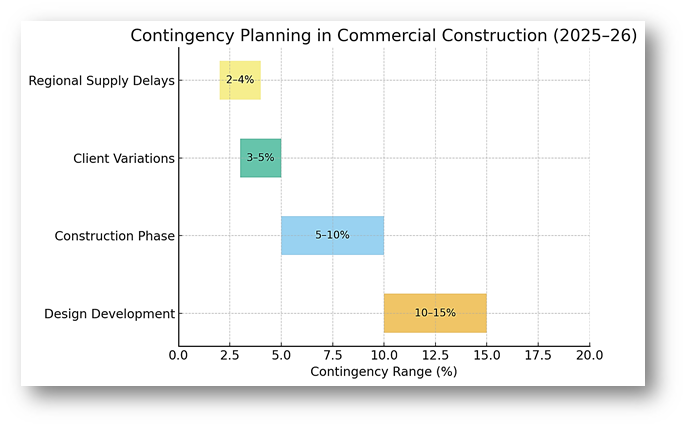
Adding structured contingency prevents under-budgeting and keeps financing realistic — especially for long-lead projects.
Procurement & Value Engineering: Reducing Commercial Building Build Cost
Controlling the cost of commercial building construction isn’t just about lowering quotes — it’s about smarter planning. Proven strategies include:
- Early Contractor Involvement (ECI): Contractors flag buildability issues before design lock-in.
- Alternate Materials: Precast panels or composite decks can save up to 15%.
- Modular Construction: Reduces labor intensity and site overheads.
- Bulk Purchasing: Secure long-lead items early to hedge against inflation.
These steps can cut 8–20% from total commercial construction pricing without compromising quality.
Time–Cost Curve: How Scheduling Impacts Budget
The longer a project runs, the higher its indirect costs.
A simple S-curve shows how average commercial construction costs rise over time:
- 0–20%: Design, approvals, site mobilization
- 20–60%: Structural works and major trades
- 60–90%: Services installation and finishes
- 90–100%: Testing, commissioning, and handover
Optimizing scheduling not only reduces preliminaries but also helps maintain commercial building construction costs predictability.
Estimating Regional Insights for commercial construction cost
Sydney
Highest commercial building cost of construction due to skilled labor shortage and site constraints.
Melbourne
Strong competition among subcontractors keeps commercial construction cost estimator results more stable.
Brisbane
Affordable land and industrial growth make it ideal for logistics and warehouse builds. You can use best commercial construction costs per square foot calculator too.
Perth & Adelaide
Lower average cost of a commercial building but higher freight and material delivery charges for specialized components.
General Case Study Example: 1,000 m² Office Project
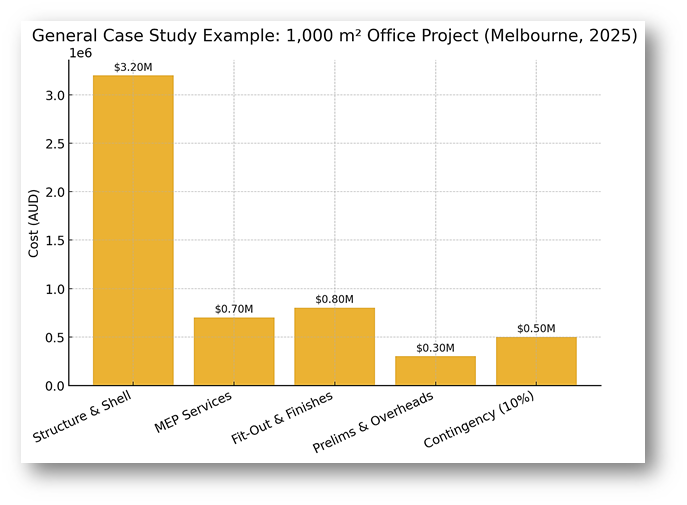
A mid-spec office building in Melbourne (1,000 m² GFA):
That equals $5,500/m² — or roughly $510 per square foot commercial, aligning with 2025 national averages.
Conclusion: Plan Smart, Build Confident
In 2025–26, Australia’s commercial construction cost estimating landscape is complex, but with the right tools and data, you can build smarter.
Whether you are budgeting a new office tower or a regional warehouse, accurate estimation ensures every dollar works harder.
Take the guesswork out of your project planning. Start with Cesol trusted solutions:Commercial Construction Estimating Services and start Planning with the precision to Build with confidence.
Frequently Asked Questions
Between $2,200 and $5,500 per m², depending on building type and city.
Around $250–$510/sq ft, with regional variance.
Use Cesol’s commercial construction cost estimator online for city-specific benchmarks.
Industry-trusted options include CostX, Buildsoft, and Cesol’s internal estimation suite.
Labour, materials, complexity, location, and procurement method.