
In construction, winning work is only half the battle; keeping it profitable is where most businesses stumble. Many contractors in Australia calculate project costs based only on wages, overlooking the biggest hidden factor: labor burden and payroll burden. These are all the extra costs that come with employing people, superannuation, workers’ compensation, payroll tax, insurance, training, and even paid downtime. When you don’t account for them properly, jobs that looked profitable on paper quickly start bleeding money in reality.
Understanding your fully burdened labor rate isn’t just an accounting exercise; it’s the difference between building a sustainable business and living from one tight-margin job to the next. The truth is, labour costs can easily make up 30% to 40% of a project’s budget. If you’re underestimating this figure, you’re undercutting yourself before the first brick is even laid.
What Does Labor Burden Actually Mean?
Most contractors think of labour costs as the hourly wage paid to a worker. If your carpenter earns $35 per hour, you may assume that’s what they cost. But in reality, by the time you add compulsory contributions, insurances, and benefits, that $35 could easily balloon to $55 or even $60 per hour. That’s your true cost per productive hour, and if it’s not calculated, your estimate is already flawed.
The labor burden definition covers everything that comes with employing someone: the safety gear they wear, the time they spend on mandatory inductions, their superannuation, the premiums for workers’ compensation insurance, and even paid breaks or travel between job sites. None of these costs are optional, and ignoring them is one of the main reasons contractors lose money even on projects they thought were priced well.
Labor Burden vs. Overhead: Why the Difference Matters
One of the biggest mistakes contractors make is mixing up labor burden with overhead. Both are indirect costs, but they are not the same. Overhead is the general cost of running your business, rent for your office, company-wide software, admin salaries, and utilities. Labor burden, on the other hand, is directly tied to having people on payroll.
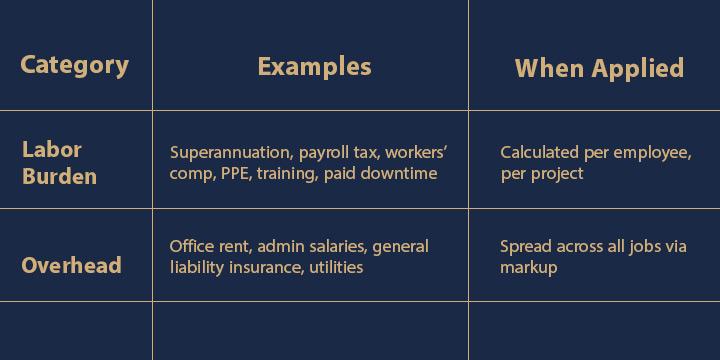
If you group them together, your job costs will be inaccurate. Overhead is recovered through a company-wide markup across all jobs, but labor burden needs to be charged per worker, per project. This separation gives you precise control, ensuring one project isn’t secretly funding another.
| Category | Examples | When Applied |
| Labor Burden | Superannuation, payroll tax, workers’ comp, PPE, training, paid downtime | Calculated per employee, per project |
| Overhead | Office rent, admin salaries, general liability insurance, utilities | Spread across all jobs via markup |
By getting this distinction right, you stop undercharging clients and start pricing jobs with full confidence.
Breaking Down the Real Costs Inside Labor Burden
To understand your fully burdened labor rate (FBLR), you need to unpack every cost attached to an employee beyond their wage. In Australia, these can include:
- Superannuation Contributions – compulsory employer-paid retirement savings.
- Payroll Tax & Leave – state payroll taxes plus annual, sick, and holiday leave.
- Workers’ Compensation Insurance – premiums based on your trade and safety record.
- Health & Safety Compliance – mandatory PPE, inductions, and WHS training.
- Non-Productive Paid Time – breaks, travel between sites, toolbox meetings.
Before you even get to adding overhead or profit, these costs significantly increase the true hourly rate of your workforce.
How to Calculate the Fully Burdened Labor Rate (FBLR)
A simple wage figure is misleading. To find your true cost per productive hour, use this four-step process:
- Start with Base Wage – e.g., $35/hour carpenter.
- Add Mandatory Burden Costs – super, payroll tax, insurance.
- Include Voluntary Benefits – training, allowances, retention incentives.
- Divide by Actual Productive Hours – remove non-productive time like breaks, leave, and meetings.
For example:
| Cost Component | Annual Value | Notes |
| Base Wages | $72,800 | $35/hour × 2,080 hrs |
| Superannuation (11%) | $8,008 | Compulsory in Australia |
| Payroll Tax (varies by state) | $3,200 | Estimate for NSW |
| Workers’ Comp Insurance | $4,500 | Based on trade risk |
| Paid Leave + Non-Productive | $7,500 | Holidays, sick leave, training |
| PPE & Compliance | $1,500 | WHS gear, certifications |
| Total Labor Burden | $97,508 | True annual cost |
Divide this by actual productive hours (say, 1,700 after leave/downtime), and the true hourly cost = $57/hour, not $35/hour. That’s your FBLR.
Why Labor Burden Matters for Every Contractor
If you’re bidding based only on wages, you’re leaving serious money on the table—and possibly setting yourself up for losses you can’t recover from. The true cost of labour in construction goes far beyond the hourly rate you pay your crew. Every worker carries hidden costs like payroll tax, insurance premiums, superannuation, safety compliance, downtime, and training. Ignoring these factors means your bids look competitive on paper but bleed profit in reality. This is why accounting for labour burden isn’t just good practice, it’s non-negotiable for building accurate estimates, protecting margins, and winning tenders that actually deliver profit at the end of the job:
- Accurate Bidding: You stop underpricing and protect your margins.
- Cash Flow Stability: You can predict costs without nasty surprises mid-project.
- Fair Client Pricing: Clients get a transparent, professional estimate that builds trust.
- Compliance Confidence: You avoid penalties and stay aligned with WHS and tax rules.
- Long-Term Profitability: You turn estimating into a financial control tool, not guesswork.
Without labor burden, you’re not just guessing, you’re gambling.
The Hidden Costs Contractors Often Forget
When most people think about labour costs in construction, they stop at wages, tax, and insurance. But if you’ve ever managed a site, you know the real picture runs much deeper. The true cost of labour isn’t just what’s written on a payslip; it’s the ripple effect of hidden factors that can quietly eat into your margins. These overlooked costs creep in through staff turnover, compliance pressures, safety records, and even paid downtime. Understanding them is what separates struggling contractors from those who build profitable, sustainable businesses.
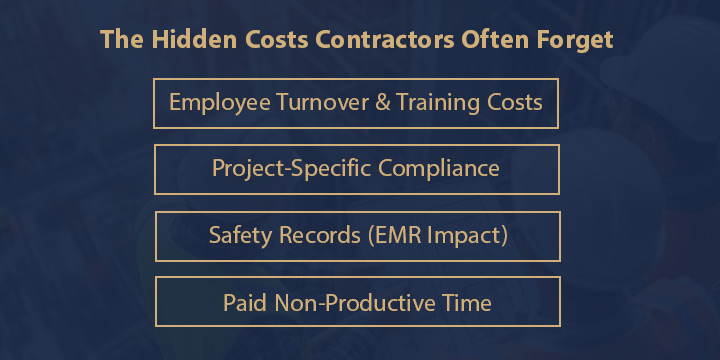
The real difference comes from catching the overlooked factors:
- Employee Turnover & Training Costs – replacing a skilled worker can cost 30–50% of their salary.
- Project-Specific Compliance – government or council jobs often demand higher insurance and extra training.
- Safety Records (EMR Impact) – poor safety history means higher workers’ comp premiums and fewer tenders won.
- Paid Non-Productive Time – every minute of travel, toolbox talks, or downtime adds up.
Acknowledging these makes your pricing bulletproof.
Technology & Tools to Track Labor Burden in Real Time
Guesswork isn’t enough in today’s construction industry. Smart contractors in Australia are now using construction estimating software and job costing apps to track the real cost of their crews.
- Time Tracking: Automatically records hours worked vs. productive time.
- Automated Cost Allocation: Assigns super, insurance, and benefits per job.
- Real-Time Alerts: Flags cost overruns before they eat into profits.
- Integrated Estimation: Syncs with your landscape estimating software or construction bidding tools for full visibility.
By using tools like this, you stop discovering losses weeks later in accounting and start controlling them on-site, in real time.
Why This Knowledge Gives You a Competitive Edge
Contractors who master labor burden have an instant advantage. They can bid competitively without undercutting themselves, explain costs transparently to clients, and build trust with councils, schools, and developers who demand polished, defendable tenders.
Meanwhile, competitors who still bid “off the wage rate” find themselves stuck in disputes, short on cash flow, and unable to scale into larger government and commercial projects.
CESOL’s Approach: Making Labour Costs Work for You
At CESOL, we know Australian contractors need more than numbers, they need confidence. Our estimating and cost planning services don’t just crunch wages; we calculate fully burdened labor rates that protect your profit on every job. Whether you’re pricing a council landscaping tender, a school upgrade, or a multi-million-dollar government project, we build estimates that factor in every hidden cost, so your bids are sharp, compliant, and future-proof.
With over 10 years of experience in construction estimating across Australia, we help contractors avoid the common mistakes that eat into margins. Our goal is simple: to give you the kind of estimates you can use tomorrow, not PDFs you need to rebuild.
Conclusion: Stop Guessing, Start Growing
Labor burden isn’t just another accounting term, it’s the invisible cost that makes or breaks your profit. By calculating the fully burdened labor rate correctly, you protect your margins, win trust with clients, and unlock the confidence to scale your business into bigger, more lucrative projects. Don’t let hidden costs drain your success, partner with professionals who know how to make every hour on-site count.
Get accurate, defendable estimates with CESOL’s expert construction estimating services—your profits depend on it.
FAQs: Labor Burden in Construction
Labor burden is the total cost of employing a worker beyond their base wage. In Australia, it includes superannuation, workers’ compensation, payroll tax, insurance, PPE, paid leave, and downtime. For example, a carpenter paid $35/hour may actually cost closer to $55/hour once these costs are added. Calculating this hidden expense ensures your construction estimates reflect the true project cost.
To calculate the FBLR, start with the worker’s wage, add all mandatory costs (super, payroll tax, workers’ comp), include benefits and allowances, then divide by actual productive hours worked. This shows the real hourly cost of an employee. Without this step, contractors underprice bids and risk losing profitability.
If you only price jobs using base wages, your bids will look cheaper but won’t cover your real costs. Labor burden ensures accurate, defendable pricing that protects profit margins, improves cash flow, and builds client trust. For large projects like government tenders, factoring in the labor burden is often a compliance requirement.
Many contractors forget about non-productive paid time (breaks, travel between sites), project-specific compliance costs, safety gear, and the long-term effect of employee turnover. Ignoring these leads to surprise expenses mid-project. A clear labor burden rate estimate ensures these hidden costs are included upfront, avoiding disputes and losses later.
Yes. Construction estimating software and job costing apps automatically allocate labor burden like super, insurance, and benefits to each job. They track productive vs. non-productive hours and flag overruns early. For those asking how to figure labor burden, it means adding all indirect costs—taxes, super, insurance, training, downtime- on top of wages, so bids reflect true labor costs and stay profitable.