
Your site is not just a web presence anymore; it is usually the first point of contact between you and a prospective customer. By the time a person has sent you an email or even called your office, he or she has already formed opinions about your business through your site. The deal used to be closed with the help of a professional handshake; nowadays, the handshake occurs online. Well-designed web UI/UX design will help make that interaction a pleasant experience and will be remembered, whereas a poorly-designed one might silently direct potential clients to your competitors.
This initial impression is important to contractors, agencies, and e-commerce businesses. An attractive site supported by considerate ux web development is not just a site that appears to be well polished. It leads visitors in the right direction, conveys professionalism, and eliminates friction in such a way that individuals can move to the next stage, whether it is requesting a quote, subscribing to updates, or making a purchase. UI/UX is the key to growth when you consider your site as a sales engine rather than a digital brochure.
Role of UX/UI in Web Development
Speaking about UI/UX, we should realise that it is not only about the attractiveness of a website. It is a matter of making it practical, responsive and aligned with the way people think and act. The purpose of UX/UI in web development is to balance the pleasing visuals with easy navigation in a way that the visitors not only spend more time but also do something significant, such as requesting a quote, completing a form, or purchasing a product. This is particularly essential to businesses in such sectors as construction, e-commerce, or professional services, where the first impression can be the difference between getting and losing a client.
A well-designed interface immediately communicates trust. Research shows that most users form an opinion in less than a second, and almost all of it is based on design. This is why UI/UX for responsive web design is not optional. A customer browsing on their phone should enjoy the same seamless experience as one on a desktop. From faster page load times to easier navigation, responsive design is the foundation of conversions. Without it, businesses face high bounce rates and wasted advertising budgets.
Why Prioritise UI/UX Designs
The other significant reason why ux design and web development should be given priority is that it has a direct connection with ROI. Even a minor change in design, layout, or CTA text can increase conversions by twice or even three times. Think of investing in a site upgrade and realising that you are not only getting more visitors, but more paying clients. That is the strength of UX design for web developers when implemented with business objectives. In the case of service companies, agencies, or online stores, UI/UX is not a side-show anymore; it is the source of revenue, loyalty, and credibility.
To put this into perspective, let’s look at some of the most impactful benefits of UI UX web development. Businesses that treat UX as strategy, not decoration, see improvements across lead generation, brand image, and client retention. Below are some of the key outcomes of prioritising user-centred design.
- A higher conversion rate due to intuitive navigation and engaging design.
- Lower bounce rates because visitors can easily find what they need.
- Better mobile experience, resulting in stronger customer return rates.
- Increased trust and credibility through professional visuals and certifications.
- Faster site speeds, reducing abandonment and boosting SEO rankings.
Quantifiable Impact of UI/UX Investment
| Impact Area | Without UI/UX Focus | With Strong UI/UX Web Development |
| Conversion Rates | Average or below industry | Increase up to 200–400% |
| Bounce Rate | High (50–70% visitors leave) | Reduced by 25–40% |
| Mobile User Retention | Low return traffic | 70%+ more likely to revisit |
| Brand Perception | Outdated, low trust | Professional, credible, reliable |
| ROI | Poor ad spend wasted | Every $1 invested returns a high ROI |
What Does UI/UX Stand For and Why It Matters
The term UI/UX stands for User Interface and User Experience. While they sound similar, they serve different purposes in web development and UI UX design. The interface (UI) includes the buttons, layouts, colours, and typography that people see. The experience (UX) covers the entire journey a user takes on your site, from the first click to the final action. A stunning interface attracts attention, but without smooth UX, fast speeds, clear paths, and easy forms, visitors will still leave.
For a freelance web developer, front end web developer, or even a full website development company, mastering this combination is critical. UI ensures that the brand looks polished and professional, while UX ensures that visitors achieve their goals effortlessly. Together, they form the backbone of any modern website design and development services.
The ROI of UI/UX: Why It’s a Business Decision
Investing in UX design for web developers isn’t about vanity. It’s about business outcomes. Every interaction on your site influences whether a visitor stays or leaves. Clean navigation, fast loading speeds, and clear calls-to-action directly translate into higher revenue and stronger customer retention.
Consider this:
- A well-designed interface can increase conversions by up to 200%.
- Strong UX can increase conversions by 400%.
- Every $1 invested in UX design has the potential to return $100 in value.
- 88% of users say they won’t return after a poor online experience.
The numbers speak for themselves. Ignoring ui ux web development doesn’t just cost clicks, it costs opportunities, contracts, and client trust.
Why Responsive and Mobile-First UX Design is Crucial
A growing percentage of web traffic comes from smartphones. Whether it’s shopping through an ecommerce website developer, browsing a company profile, or checking services from a web development agency, users expect a mobile experience that is as smooth as a desktop. Responsive UX design automatically adapts layouts, images, and buttons to different screens. Without it, your potential customers are five times more likely to abandon your site.
Mobile-first design also improves search visibility. Search engines reward websites that are optimised for all devices, and this directly impacts how many leads you generate. Businesses that invest in ux in web development for mobile often notice that their form completion rates and quote requests double within months. This is why every shopify website developer or wordpress web developer now prioritises responsive design as a non-negotiable step in the process.
Bad vs High-Converting Contractor Website
| Feature | Poor Design Example | High-Converting Example |
| Navigation | Cluttered menus, technical jargon | Clear labels, 5–7 menu items |
| Speed | Slow load, heavy images | Optimised speed, instant interaction |
| Mobile View | Pinch and zoom required | Responsive, mobile-friendly |
| Trust Signals | No testimonials, hidden contact | Licenses, reviews, visible phone/email |
| Portfolio | Random images, no structure | Filterable projects with results shown |
| Call-to-Action (CTA) | Buried links, generic “Submit” | Bold buttons, “Request Pricing” |
Choosing the Right Partner for UI/UX and Web Development
Once you understand the importance of user-focused design, the next step is choosing the right partner. Whether you hire a wordpress website designer, a shopify website developer, or a freelance web developer, make sure they understand more than just code. A strong web development company should combine website design and development services with UI/UX expertise to ensure your site not only looks good but also performs well.
For businesses looking to build ecommerce websites or launch web applications, working with a web development agency that offers website and app development can save time and money. This approach ensures a single team handles both design and user experience, delivering a consistent journey for customers. It also reduces overall website development costs by avoiding rework and fragmented services.
Psychology of Conversion: Why People Click or Leave
Behind every click and every form submission, there is human behaviour. The psychology of conversion plays a central role in how UX design and web development influence decisions. A website may look modern, but if it creates friction, visitors lose interest fast. This is why concepts like cognitive load, social proof, and trust perception are crucial. By addressing these elements in UI/UX web development, businesses can create a user journey that feels effortless and trustworthy.
One of the most overlooked issues is cognitive load. When a site throws too many options at a visitor, it creates confusion and decision fatigue. The user ends up leaving instead of choosing. A simple navigation menu with 5–7 clear items is often more effective than a complex structure. Similarly, long forms with 15 fields discourage people, while short, UX-friendly forms with essential fields drive completions. Less clutter means more conversions.
Another powerful principle is social proof. People are far more likely to trust your business if they see that others have already worked with you successfully. Displaying testimonials, reviews, certifications, and logos of past clients builds immediate credibility. A creative website UI design that integrates these trust signals directly on service and portfolio pages performs much better than one that hides them on a separate page. For contractors or agencies, this simple design choice can be the difference between a lost visitor and a booked consultation.
Case Studies: Real Proof That UX Delivers Conversions
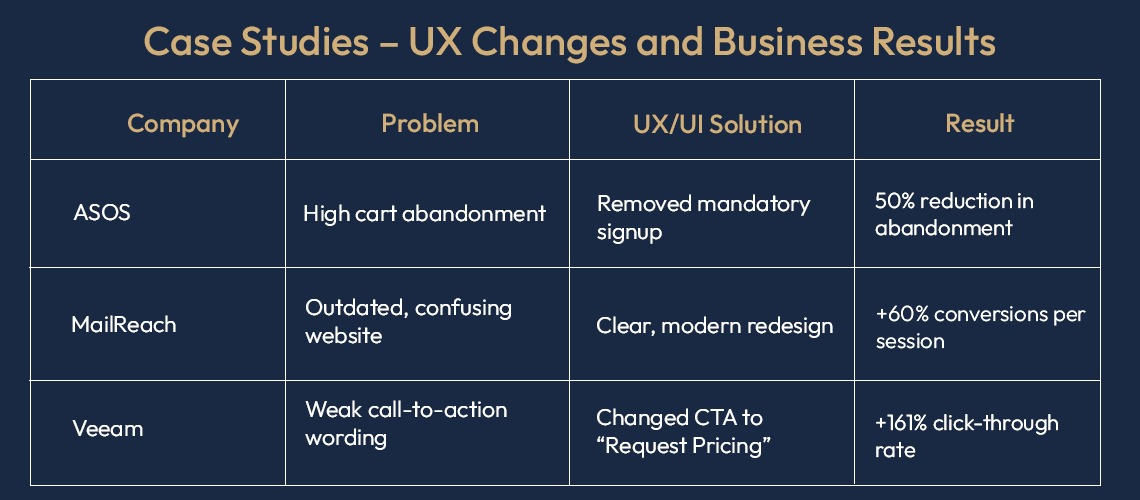
Sometimes the best way to understand the value of UI/UX in web development is through real-world examples. Across industries, small improvements in UX have delivered massive financial gains. Below are three case studies that highlight how web development and UI UX design drive measurable results.
- ASOS: The fashion retailer had high cart abandonment due to mandatory registration. By removing that friction and allowing new customers to simply continue, they cut abandonment rates by half. For businesses, this shows how small ux design for web developers can remove barriers and double conversions.
- MailReach: Their old site looked outdated and unclear, causing trust issues. After a redesign focused on simplicity and clarity, conversion rates per session rose by 60% and per user by 82%. This mirrors the need for a modern, professional wordpress website designer or shopify website developer when building e-commerce or B2B platforms.
- Veeam: The company tested two CTAs, “Request a Quote” vs. “Request Pricing.” The second option increased click-throughs by 161%. This proves that thoughtful UX in web development, even in button copy, can dramatically improve engagement.
Case Studies – UX Changes and Business Results
| Company | Problem | UX/UI Solution | Result |
| ASOS | High cart abandonment | Removed mandatory signup | 50% reduction in abandonment |
| MailReach | Outdated, confusing website | Clear, modern redesign | +60% conversions per session |
| Veeam | Weak call-to-action wording | Changed CTA to “Request Pricing” | +161% click-through rate |
These case studies prove that even small UX changes can deliver major ROI. For a web development agency or a freelance web developer, this is a reminder that conversion optimisation is as important as coding or design.
Emerging Trends in UI/UX Web Development
The digital landscape never stands still. The future of web UI/UX design is being shaped by technology, user expectations, and accessibility standards. Businesses that adopt these emerging trends now will enjoy a competitive edge in both user engagement and conversions.
One of the biggest shifts is AI-powered personalization. Instead of static pages, AI-driven websites adjust content, CTAs, and even layouts based on visitor behaviour. For example, an ecommerce website developer can integrate product recommendations tailored to browsing history, while a web app development team can create dashboards that adapt to user preferences. This level of personalisation makes customers feel understood, increasing retention and purchase rates.
Another important trend is accessibility by design. Modern website design and development services must comply with accessibility standards, ensuring websites are usable for everyone, including people with disabilities. Features like clear typography, proper colour contrast, alt text for images, and keyboard-friendly navigation are not only ethical but also build trust. A website that is inclusive signals professionalism and reliability, especially for government contractors and agencies.
Finally, mobile-first and multi-device design remains at the heart of UX. From smartphones to tablets and desktops, users expect flawless performance across platforms. Future-ready best web developers are also focusing on sustainability, lighter code, optimised media, and efficient hosting that lowers load times while reducing digital carbon footprints. Businesses that embrace these trends show that they care about their users and the planet, strengthening brand loyalty.
The future of UI/UX web development is dynamic and user-focused. Three trends stand out:
- AI Personalisation: Websites that adjust layouts, CTAs, and recommendations in real time.
- Accessibility: Inclusive design that meets WCAG standards, making websites usable for everyone.
- Sustainable Design: Lightweight code and optimised media that load faster and reduce digital carbon footprints.
How CESOL Helps Contractors and Agencies Win with Better UX
At CESOL, we believe that UI/UX web development is more than design; it’s a strategy. Our expertise in website design and development services goes hand-in-hand with our background in construction estimation and capability statements. This unique blend allows us to build websites that don’t just look professional but actively support credibility, compliance, and client acquisition.
For contractors and agencies, we create portfolios that act as sales engines. Instead of random project images, we design case-study-style showcases with clear outcomes, testimonials, and CTAs like “Request Pricing.” By combining UX web development with storytelling, we help businesses stand out in tenders and competitive markets.
We also build trust into every website. From licenses and certifications to testimonials and project data, we ensure that the website communicates professionalism. For ecommerce website developers or service providers, this approach means more completed forms, more qualified leads, and stronger conversion rates. By optimising navigation, forms, and mobile performance, CESOL websites become lead-generation machines, not just digital brochures.
Whether you need a WordPress website designer, a Shopify website developer, or a full web development agency, CESOL ensures that UI/UX is at the centre of every decision. With our approach, businesses don’t just get a website; they get a strategic tool designed to win contracts, attract clients, and boost revenue.
Conclusion
A modern website is no longer just an online brochure; it is your first impression, your trust signal, and your lead-generation engine. Businesses that treat UI/UX in web development as a strategic investment consistently see higher conversions, stronger credibility, and long-term client relationships. From faster load times to clear CTAs and mobile-first design, every detail matters in turning visitors into loyal customers. At CESOL, we focus on building websites that not only look professional but also align with your business goals, whether that’s winning tenders, attracting more project inquiries, or scaling your online presence. By blending design, strategy, and industry expertise, we help contractors and agencies transform their websites into powerful tools for growth. Visit the Website for more details.
FAQs
UI/UX ensures that a website is both visually appealing and easy to use. Web UI/UX design focuses on creating intuitive navigation, faster performance, and responsive layouts that improve conversions. Good UX means users complete tasks easily, from browsing services to submitting a form.
Strong UI/UX is critical because it impacts trust, engagement, and sales. Research shows that most first impressions are design-related, and poor UX leads to high bounce rates. Whether working with a web development agency or a freelance web developer, prioritising UX leads to higher ROI.
UI/UX stands for User Interface and User Experience. UI refers to the look of a website, its layouts, colors, and typography, while UX covers the entire journey, including navigation, forms, and usability. Both are essential for effective website design and development services.
Website development costs depend on project scope, platform, and design complexity. A simple site built by a WordPress web developer may cost a few thousand dollars, while an ecommerce site from a Shopify website developer or full web application development project can range much higher.
Some of the best UI/UX websites are those with clean navigation, responsive layouts, and clear CTAs. Design award platforms showcase creative website UI design, but for practical examples, contractor and ecommerce sites with strong UX web development often set the benchmark.