
Imagine trying to explain a building layout or interior design using only flat 2D sketches. Clients often struggle to visualize the end result, leading to confusion, delays, and costly changes. This is where 3D rendering services step in.
Today, 3D rendering in construction industry and interior design is no longer optional—it’s a necessity. With the rise of construction rendering software and 3D interior visualization software, architects, builders, and designers can now create photorealistic visuals that make projects come alive long before construction begins.
In this article, we will explore the key benefits of 3D rendering services for construction and interior projects, examine how 3D modeling in construction is changing the game, and highlight why choosing the best 3D rendering for construction and interior design projects can be your competitive advantage.
Why 2D Plans Don’t Cut It Anymore
Have you ever tried explaining a design to a client using only flat blueprints? They nod politely, but deep down—they can’t really picture it. That confusion often leads to delays, expensive last-minute changes, and frustration on both sides.
How frustrating is it to spend weeks of your time working on a construction project only to hear a client say, That is not what I expected. You are now left with expensive revisions, time wastage and dissatisfied customers.
In the modern competitive environment, sketching or 2D plans are no longer a simple thing to rely on, it is dangerous. This is the very point where 3D rendering services come in. After construction making software and a 3d rendering software for construction you are able to make things alive- long before one single brick is set. In the construction works of a home or even in interior design rendering, 3D technology does away with guesswork, instills confidence and provides you a clear cut competitive edge.
How 3D Rendering Is Revolutionizing Design: A Quick Snapshot of Benefits of 3D Rendering
| Benefit | Impact on Construction Projects | Impact on Interior Projects |
| Photorealistic Visualization | Helps clients see the building before it’s built | Shows materials, lighting, and finishes in detail |
| Improved Communication | Aligns contractors, architects, and stakeholders | Bridges gaps between designers and clients |
| Error Detection | Identifies design flaws early | Tests furniture placement & lighting before execution |
| Cost & Time Savings | Reduces expensive mid-project changes | Speeds up approval cycles |
| Marketing & Sales | Pre-sell properties with lifelike visuals | Showcase portfolios with stunning imagery |
Fact: Real estate developers using 3D rendering services report a 25–30% faster sales cycle compared to those relying on 2D plans.
The 7 Practical Benefits of 3D Rendering
Adopting 3D rendering services for construction and interior design is not just about making a project look attractive on paper. The real strength lies in how it delivers measurable, long-term value across the entire project lifecycle.
1. Photorealistic Visualization & Design Clarity
The fact that the picture generated by the use of 3D rendering and 3D visualization can be so realistic that a client believes that he/she is walking in the space that is already completed is one of the largest advantages of working with this software.
Indicatively, 3D rendering in residential building projects enables the developers to display the precise exterior appearance, landscape, and even illumination. In the same manner, the interior design 3D models that are available assist the homeowners in imagining the furnishings arrangement, wall texture, as well as lighting layouts.
Through this clarity on the first page, architects and other designers employing the 3D rendering software in designing the buildings minimize confusion and lead to uninterrupted and faster project approvals.
2. Improved Communication & Stakeholder Alignment
In construction and interior projects, poor communication often leads to disputes and delays. With construction 3D rendering, every stakeholder—from clients to contractors—has a clear visual reference.
- Clients who are unfamiliar with blueprints can now see exactly what their dream home or office will look like.
- Contractors rely on 3D design rendering to execute projects with precision.
- Designers use 3D interior visualization software to collaborate with clients in real time.
This ensures that everyone stays aligned, reducing costly revisions and avoiding frustration.
3. Error Reduction & Early Detection
Errors discovered late in construction can drain budgets. 3D modeling in construction helps spot design flaws before they become real problems.
For instance:
- Architects can detect structural conflicts.
- Builders can simulate lighting and ventilation in 3D rendering home design models.
- Interior designers can see how different layouts affect flow and usability.
By addressing these challenges early with 3D rendering construction software, companies save time, money, and resources.
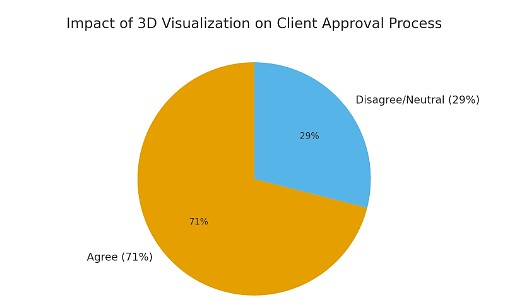
- Here’s the graph showing that 71% of architects and interior designers agree 3D visualization has shortened client approval times by at least 50%.
4. Faster Iterations & Greater Design Flexibility
Traditional design revisions required hours of redrawing or costly physical models. With 3D rendering for construction and 3D interior visualization, changes happen in seconds.
Want to see how a living room looks with an open floor plan? Or test a new exterior color scheme? 3D model rendering tools make it possible to switch materials, layouts, and finishes instantly.
This flexibility accelerates decision-making, gives clients more control, and ensures faster approvals.
5. Elevated Marketing & Sales Power
Another underrated benefit of 3D rendering services for interior design and construction is its value in marketing.
- Real estate developers use 3D interior renderings to pre-sell units before construction.
- Interior design rendering services showcase portfolios on websites and social media with high-impact visuals.
- Construction firms use animations and 360° tours created with the best 3D rendering software for architecture to impress investors and clients.
In today’s digital-first world, strong visuals are your best sales tool.
6. Customization & Versatility
Not all clients have the same tastes. With 3D rendering interior design software, you can customize everything—paint colors, furniture placement, lighting intensity, and materials—before any work begins.
This makes 3D rendering not only a design tool but also a personalization service, ensuring each project reflects the client’s unique vision.
Beyond homes and offices, rendering services extend into:
- Product design
- Retail marketing
- Urban planning
This makes 3D rendering services one of the most versatile solutions in modern industries.
7. Emerging Technologies in 3D Rendering
Virtual Reality (VR) Walkthroughs
With VR, clients can virtually step inside their future home or office, spotting issues in 3D interior design renderings before they happen in real life.
Augmented Reality (AR)
AR allows architects to overlay 3D rendering home design models into real-world environments—perfect for site visits.
Real-Time Rendering
Advanced 3D rendering construction software like Enscape and Twinmotion let designers make instant changes during live client sessions.
Together, these innovations make the best 3D rendering for interior projects even more valuable.
“3D Rendering Software Comparison”
| Software | Best For | Key Features |
| SketchUp + V-Ray | Interior Designers | Fast rendering, realistic lighting |
| Lumion | Architects | Quick exterior visualization, landscaping |
| Enscape | Construction Teams | Real-time rendering, VR compatibility |
| Blender | Freelancers | Free, versatile, open-source |
| 3ds Max | Large Firms | Advanced realism, customizable plugins |
Facts: The global 3D rendering market was valued at $2.3 billion in 2023 and is expected to surpass $9 billion by 2030 (CAGR of over 20%).
Strategic Advantage: Why Choose 3D Rendering Now?
Most competitors highlight visualization and marketing. To go beyond, companies should:
- Share case studies showing cost/time savings.
- Offer tiered 3D rendering services (basic, advanced, VR).
- Educate clients about ROI of using 3D rendering construction services.
Positioning yourself not just as a provider of 3D interior design renderings but as a business problem-solver will set you apart.
Conclusion: Building the Future with 3D Rendering
3D Rendering is the future. Since the construction rendering software and the 3D interior visualization software, the tools nowadays have revolutionized the industry. The advantages of 3D rendering are irrefutable: improved communication, reduced errors, quicker approvals, and stronger marketing. For construction and interior professionals, the choice is clear—the best 3D rendering for construction and interior projects is the key to staying competitive. Be it a home, office, or real estate development, 3D rendering services transform ideas into life-like visuals that impress clients, investors, and buyers alike.
Now is the time to invest in 3D rendering services; if you are ready to transform client confusion into confidence and ideas into sales, explore more with Cesol.
FAQ’s
You are able to visualize the building to be constructed using 3D rendering, discover the errors at the initial stage and save the money and enhance communication among stakeholders.
It enables clients to see furniture, lighting, textures and layouts in realistic detail-approvals are quicker, and revisions are minimized for 3D Rendering for Home Construction Projects.
Both! Whether you are freelancers or big companies, 3D rendering solutions and software can fit your project requirements and budget.
The most popular are Lumion, Enscape, SketchUp + V-Ray, Blender, and 3ds Max, and each of them has its peculiarities incorporated into building and interior projects.
In pre-selling projects, impressing investors and demonstrating designs on the Internet, developers, architects, and designers resort to 3D interior renderings and visualizations of constructions under construction.