
Great projects aren’t won with guesswork; they’re won with a clear Construction estimate, tidy documents, and calm, defensible numbers. A strong baseline tells the client exactly what they’re buying, why it costs what it costs, and how risks are being handled. When you build accurate construction estimates, you replace hunches with measured quantities, current supplier quotes, and transparent assumptions. That clarity cuts out surprises, keeps teams aligned, and gives evaluators confidence that your price can actually be delivered on site.
This is the real importance of cost estimation in construction: it protects margin, smooths cash flow, and keeps delivery steady when markets move. With a disciplined approach, clean scopes, verified rates, and simple, auditable math, your numbers hold up under review and during construction. The result is fewer variations, faster approvals, and a reputation for reliability that wins repeat work.
Tip 1: Lock the scope early (and price what you’ll actually build)
Before you touch a spreadsheet, make the scope unmissable. Scope clarity is where building construction cost estimation starts and where waste disappears. Treat preconstruction like a mini project: define what’s in, what’s out, who owns each interface, and how the work will be sequenced. Capture site access limits, services, staging areas, and testing/commissioning up front so nothing hides in “TBD.” This is disciplined construction budget estimation, not back-of-the-napkin math; your quantities, assumptions, and constraints should read like a simple story anyone on the team can follow.
If the client needs a premium baseline, propose a class construction cost estimate so everyone prices to the same standard. That shared reference removes apples-to-oranges bids, speeds levelling, and keeps value-engineering honest. The clearer the scope, the easier the pricing and the fewer change orders, because your inclusions, exclusions, and sequencing are already agreed, measured, and costed.
- Run a scope workshop with the owner, designer, estimator, and key subs; document assumptions and exclusions.
- Walk the site (or use current imagery) to catch access limits, utilities, or ground risks early.
- Create a one-page scope summary that mirrors the client’s evaluation criteria, this guides your construction estimating process.
Tip 2: Pick the right method (and follow standards)
Choosing the correct construction cost estimating methods keeps risk where it belongs, visible and priced. Pick the approach that matches the design stage and complexity (parametric for early budgets, assemblies for typical tenders, detailed unit-rate for high-risk scopes), then document why you chose it. When everyone understands the method, assumptions, and data sources, your numbers are easier to defend and adjust.
Pair method with consistency. Align your breakdowns to recognised construction cost estimating standards (and Construction cost estimating standards) so labels, units, and cost codes stay uniform across the bid. Share a short, skimmable construction estimating guide, a one-pager with naming rules, measurement conventions, rounding, and inclusions/exclusions, so every estimator prices the same way, every time.
Here’s how to choose:
- Use assemblies when you need speed with structure.
- Use detailed build-ups for complex or high-risk packages.
- Always calibrate with recent actuals; your own data beats generic indexes.
Method Selector
| Method (core construction estimating techniques) | When it shines | Typical risk level |
|---|---|---|
| Analogous (past job scaled) | Very early budgets | Higher |
| Parametric (per m² / per unit) | Early design, repeatable scopes | Medium |
| Assembly-based | Most tenders with time pressure | Medium–low |
| Detailed unit-rate build-up | Complex or high-risk trades | Low (if data is good) |
Pro move: document the method you used inside the bid. Evaluators reward transparency; this is classic construction estimating best practices.
Tip 3: Let your tools do the heavy lifting
Good tech doesn’t replace judgment; it frees it. Modern construction estimating software reduces manual errors, standardises formats, and keeps your pack consistent. For larger tenders, shortlist the best commercial construction estimating software to manage alternates, versions, and VE options. On-site or in meetings, the best app for construction estimates captures counts, photos, and notes in minutes.
Heavy drawings? Choose the best computer for construction estimating so that large PDFs and models don’t stall you. For early sanity checks, a commercial building cost calculator or the best construction cost estimator app is fine, just replace “ballpark” with measured quantities before you submit.
Mindset first, then actions: let the system handle math and formatting; you focus on scope and risk.
- Keep one central cost library for labour, plant, materials, prelims, and overheads.
- Wire digital takeoff to pricing so quantity changes ripple through totals.
- Lock templates for methods, program snapshots, assumptions, and alternatives.
Tip 4: Build a living cost library (data beats opinion)
The best cost estimation in construction projects is fuelled by your own history. Treat every job like an experiment: capture estimate vs actuals, record lessons learned, and push those insights back into your cost libraries and unit rates. Over time, this living dataset reflects your crews, your suppliers, your regions, and your typical risks, so your next Construction estimate starts closer to reality and needs less “padding.” The payoff is tighter pricing, faster bid turnarounds, and fewer surprises once the shovel hits the ground.
Close the loop by tying estimating to delivery with simple construction project management and estimation dashboards so feedback is real, not guesswork. Track productivity, change orders, lead times, and variance in one place, then train the team monthly using construction estimating practice problems pulled from recent work. Short, scenario-based drills (e.g., scope shifts, price spikes, weather delays) sharpen judgment and speed, so the same people who practice improvements on paper can deploy them on live bids the very next week.
Short setup, then the list: accurate inputs make calm outputs.
- Date every rate and note the source (supplier quote, index, last job).
- Review trade productivity quarterly; update crews and output rates.
- Track market signals (lead times, escalation drivers) and price ranges.
Tip 5: Price from the bottom up
If you’ve wondered how to calculate construction cost or how to estimate construction costs so they stand up under scrutiny, start with measured quantities and proven unit rates. Build every line as quantity × unit rate, sourced from recent supplier quotes and real productivity. Note the takeoff basis, waste, and lead times right beside each item so reviewers can see exactly where the number came from.
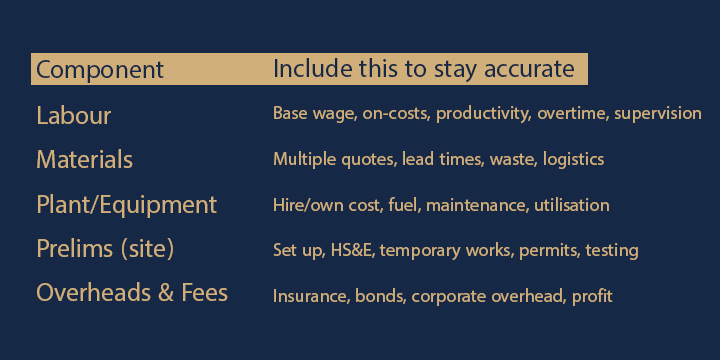
Then layer on the business realities, prelims (site setup, HS&E, temp works), overheads, bonds/insurance, and a clearly stated fee. Keep contingencies tied to named risks, not guesswork, and list inclusions/exclusions in plain language. Cross-check with control totals and past jobs, and structure the sheet so your price reads like a short story the evaluator can follow, from scope to method, to money, with no mysterious markups. Quantity drives direct cost; assumptions drive risk, make both explicit.
Cost Components (what to include)
Tip 6: Plan for risk and change (so margin survives)
Most blowouts aren’t mistakes; they’re unknowns. Keep a live, visible risk register and link every allowance to a named risk (weather, access, logistics, utilities, night works). Review it at each design stage. This simple discipline prevents the classic construction estimating mistakes to avoid: no weather buffer, no escalation logic, no access plan, and no owner/subcontractor buy-in on constraints.
For volatile inputs, use ranges (min/most-likely/max) and state the trigger points in your assumptions; e.g., steel index ↑X% or lead time >Y weeks activates an adjustment. Tie contingency to these “known-unknowns,” not to vague padding, and show how it rolls into prelims and cash flow. Writing it down isn’t overkill; it’s how you protect delivery, margin, and trust when the market moves. Contingency is for “known-unknowns,” not sloppy pricing.
- Tie each allowance to a clear risk (e.g., rock, night works, crane time).
- Use simple ranges and explain your assumptions in one sentence each.
- Keep a one-page change-control process in the appendix.
Tip 7: Buy smart—subs and suppliers make the price
For bigger jobs, apply commercial construction estimating tips that keep bids clean and defensible: do your own takeoff to benchmark sub quotes, issue one detailed scope to all bidders, and compare like-for-like with a standard bid form. Pre-qualify subs on safety, capacity, and track record; ask for alternates (spec switches) to unlock value engineering; and align program, access, and cash-flow terms so the lowest number is also buildable.
For homes and small builds, lean on residential construction estimating tips: confirm finishes and inclusions early, lock PC sums tightly, and plan lead times with suppliers before you price. Write simple assumptions/exclusions in plain language, include a sensible contingency for homeowner changes, and choose partners for capability and fit, not just price, because you’re buying outcomes, not numbers. Strong buying is half the estimate.
- Standardise sub bid forms so scopes align; reject “mystery allowances.”
- Ask for alternates (spec switches) to create real VE options.
- Negotiate beyond price: delivery windows, payment terms, lead-time commitments.
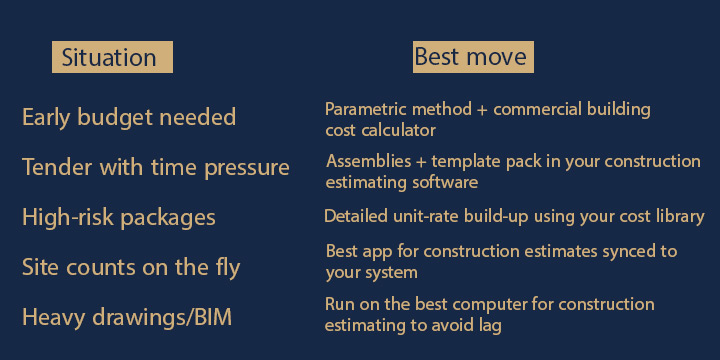
What to Use and When
Picking the right tool for the moment saves time and money. Early on, you just need a directional number, so keep it light with a parametric approach and a commercial building cost calculator. As drawings firm up or deadlines loom, switch to assemblies in your construction estimating software to move fast without losing structure. When the stakes are high, slow down and build detailed unit rates from your cost library. On site, capture real counts with the best app for construction estimates so field data flows straight into pricing. And when you’re handling huge PDFs or BIM, run everything on the best computer for construction estimating so performance never becomes the bottleneck.
Wrap-Up
When your estimate reads clean, follows construction cost estimating standards, and explains its logic, you’re easy to trust. That’s how a thoughtful Construction estimate becomes a win. Keep applying these construction estimating best practices, and your numbers will hold up in the boardroom and on the job.
FAQs About Construction Estimating Tips
Start with measured quantities and proven unit rates, building each line as quantity × unit rate from recent quotes and real productivity. Then add prelims (site setup, HS&E, temporary works), project overheads, bonds/insurance, and a clearly stated fee. Keep contingency tied to named risks instead of guesswork, reconcile control totals, and compare against similar past jobs to make sure the number stands up.
Use parametric or assembly methods to create a solid early view, explain your assumptions in plain language, and price with sensible ranges where scope is fluid. Reference the current supplier intel for provisional sums, state the triggers that would change the price, and agree on a simple plan to update figures as drawings mature.
Include marked-up takeoffs, dated supplier and subcontractor quotes, an assumptions and exclusions sheet, a short risk register, a concise method statement with a schedule snapshot, and a brief estimate-vs-actuals comparison from similar projects so evaluators can trace every figure.
Rely on modern estimating software for libraries, assemblies, and consistent reporting; pair it with digital takeoff connected to pricing, a market index or escalation tracker, a mobile app for field counts and photos that syncs back to the estimate, and BIM, where available, to validate quantities and interfaces.
Structure your breakdowns to match the tender’s cost codes, state in a line which method you used (parametric, assemblies, or unit-rate), annotate key line items with the basis of rate and lead time, tell a clear narrative from scope to method to money to risk, and finish with a strict compliance and arithmetic check before you upload